

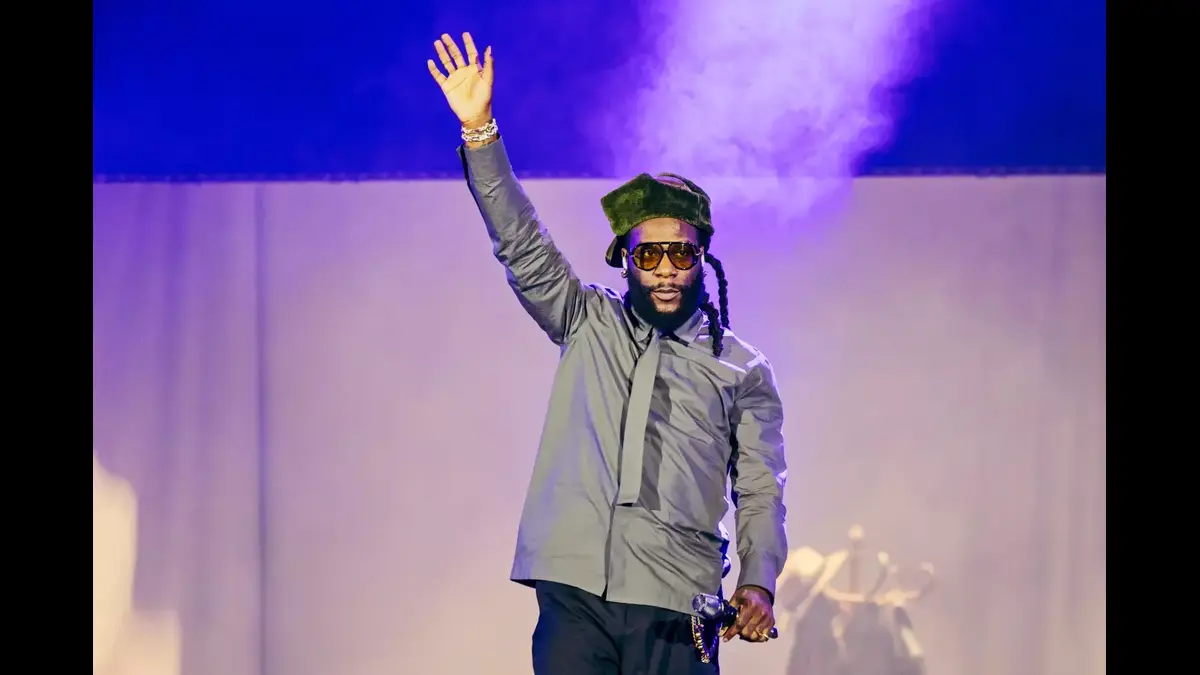
The world of live music is supposed to be magical with artists and fans sharing in the energy, a kind of unspoken contract that say’s, I’ll give you my best, and you’ll meet me halfway. But a recent incident at Burna Boy’s concert in Colorado challenged that assumption. What happened at Red Rocks Amphitheatre, where he stopped mid-set to call out a sleeping couple in the front row, has sparked a firestorm.
Burna Boy, clearly giving everything he had that night, paused his performance after spotting a man and his girlfriend asleep near the front. In a video that quickly went viral, he pointed at them and said:
“When I stand up here and see you with your girl sleeping … that’s where y’all f* off. Please, take her the f*** home!”
He refused to continue until they were escorted out and the crowd watched, stunned, as security did just that.
Yes, the moment was dramatic, but there’s a deeper tension that is being highlighted. It’s not just about concert etiquette. It’s about exhaustion, empathy and what it really means to be seen at a show.
According to attendees, Burna Boy had revealed earlier that he was sick. He said he almost canceled the show, was constantly stopping for water and seemed to be physically pushing himself. So, when he saw people dozing off near the front row, it clearly struck a nerve. He felt disrespected, not just as a performer, but as a human giving everything on stage.
The woman who was kicked out later identified herself as Chaltu Jateny. She said she was “mentally, physically, and emotionally drained”, grieving the death of her child’s father. IHer words were a gut punch:
“If I wanted to close my eyes and sleep … I can do that. It is my money I wasted, not his.”
She wasn’t there to disrespect anyone. She was simply worn out, seeking solace at a concert she had paid for.
The backlash was swift and loud, and it touched on something real in today’s world. That being fame, vulnerability and responsibility. Some people say Burna Boy’s reaction was harsh and that he should have checked in, not humiliated her. While others argue that artists deserve respect, especially when they’re giving all they have, physically and emotionally. But everyone seems to agree on one monumental question, this moment forced people to ask how much empathy exists in entertainment spaces. It also raised a larger question, should concert expectations evolve? Should there be a recognition that not every fan walks in with boundless energy. Sometimes, fans bring grief, exhaustion and mental health burdens along to the show.
This isn’t just clickbait or a weird concert anecdote. It’s a moment that’s become part of a growing conversation about the relationship between artists and their audiences.
- For artists: It’s a reminder that, yes, performance is demanding, but sometimes, the front row is not just a sea of energy, it’s a mirror.
- For fans: It’s a call to acknowledge that our emotional states don’t pause for shows.
- For everyone: It’s a push to reimagine what compassion looks like in these spaces.
Maybe the takeaway isn’t about who was “wrong” or “right.” Maybe it’s simply this, even a superstar is just a person navigating a difficult day, and every fan is too.
If I were writing this for my newsletter or blog, I might end with a question, that asks, How do we hold space for both the artist’s need to perform and the humanity of every person in the crowd? Because after all, that messy middle is where empathy lives.
