



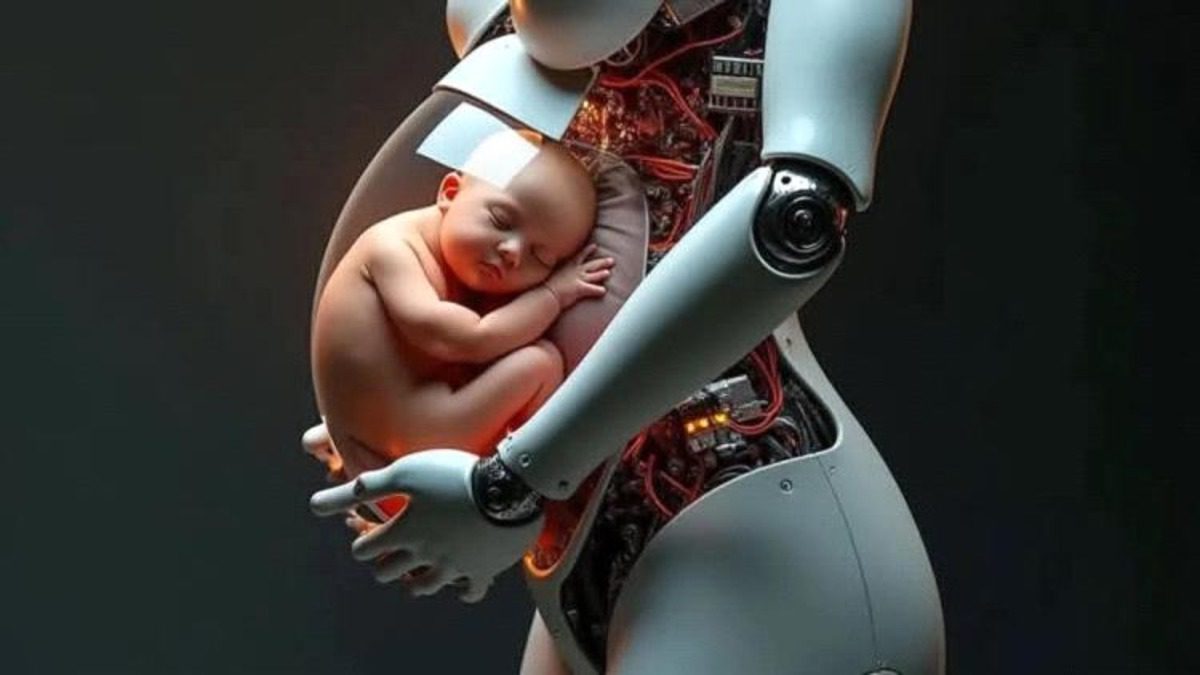
If you thought flying cars or robot butlers were wild, buckle up. A Chinese robotics company just pitched something straight out of Black Mirror: a humanoid robot that can carry a pregnancy.
Yep. You read that right: a robot with a womb.
At the 2025 World Robot Conference in Beijing, Kaiwa Technology unveiled plans to build the world’s first humanoid robot with an artificial uterus. They’re promising a working prototype by 2026, with a price tag of less than $14,000.
Wait… Why?
According to Dr. Zhang Qifeng, the lead mind behind the project, the goal is to mimic the process of human pregnancy outside the body. The humanoid would have an artificial womb filled with fluid and nutrients, designed to grow a baby from embryo to birth.
In theory, parents could “bond” with their unborn child by interacting with the humanoid while the pregnancy develops. Imagine visiting your “pregnant” robot every day, watching it carry your child.
It’s the kind of concept that makes you pause. On one hand, it’s groundbreaking. On the other, it’s unsettling because it touches one of the most intimate and human experiences we know.
The Science vs. The Hype
Here’s the reality check: full artificial pregnancy is still very far away. Scientists have managed to keep premature lambs alive in “biobags,” but going from fertilization all the way to delivery is another level entirely.
That means Kaiwa’s robot might be more vision than reality, at least for now. Some experts have even suggested that these types of announcements lean closer to stunts than breakthroughs. But the fact that this is even being discussed shows how quickly biotech and robotics are colliding.
The Big Ethical Question
Let’s say this actually works. Who decides who can use it? How would parenthood be redefined if robots could carry babies? And would society accept children born outside a human womb as easily as those born naturally?
Dr. Zhang has already started talking to lawmakers in Guangdong Province about drafting regulations. That’s smart, because the ethical debate here is going to be massive. We’re not just tinkering with tech anymore, we’re tinkering with what it means to be human.
More Than Baby-Bots
This wasn’t the only futuristic demo at the conference. Robots powered by AI are now being pitched for farming, healthcare, and even breeding plants. The artificial womb bot might have stolen the spotlight, but the bigger story is clear: China is going all-in on robotics that push the edges of comfort.
Final Thoughts
Here’s the thing: Kaiwa’s “pregnancy robot” is equal parts fascinating and terrifying. If it delivers, it could offer hope to families who can’t conceive naturally. But it also cracks open a Pandora’s box of ethical, emotional, and social questions we’re nowhere near ready to answer.
For now, it feels less like a product launch and more like a sneak peek at a future we’re not sure we want. The line between science and science fiction just got blurrier, and the world is watching to see if this is a revolution or just a really wild experiment.


