

Just when you thought ASUS was done making its point with the grown-up, emotionally stable Zephyrus G14 and G16, it did what it always does when it gets confident.
It went weird again. On purpose.
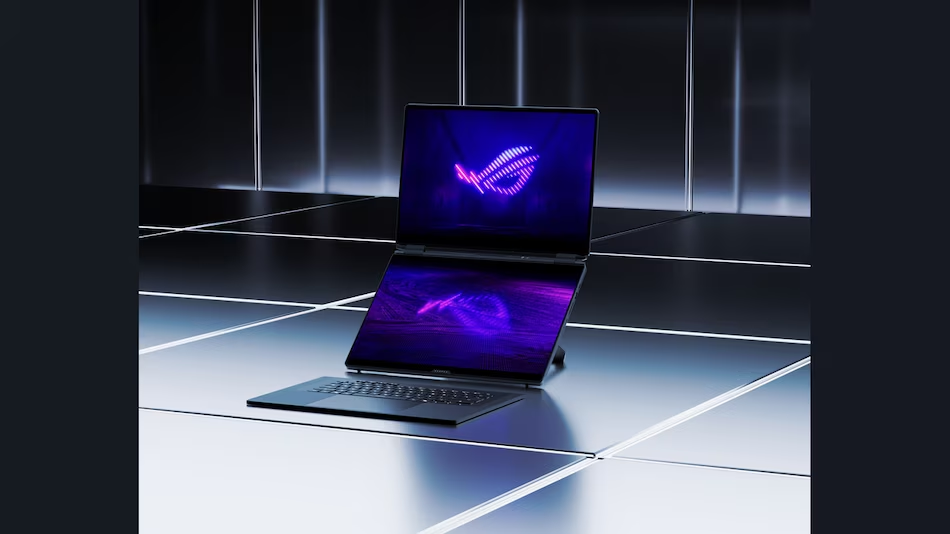
Meet the new Zephyrus Duo, a machine that does not politely ask whether you need two screens. It assumes you do and builds the entire laptop around that belief. According to ASUS Republic of Gamers, this is the world’s first 16-inch dual-screen OLED gaming laptop, and it is very clearly not trying to appeal to everyone. That is precisely the point.
Two OLED Screens, Zero Apologies
The headline feature is obvious and unapologetic. Two 16-inch 3K OLED touchscreens stacked into a single machine, delivering more than 21 inches of total screen real estate.
Both panels are ROG Nebula HDR OLED displays. Both hit 120Hz. Both offer 0.2ms response times, 100 percent DCI-P3 coverage, Delta E values under 1, and up to 1100 nits of peak brightness with VESA DisplayHDR True Black 1000 certification.
This is not a gimmick panel glued on for email. This is two fully professional-grade displays in one device. One for the game or timeline. One for chat, tools, code, OBS, Discord, or whatever else you normally juggle across multiple monitors.
It is not subtle and it’s definitely not trying to be.
A Laptop That Refuses to Sit One Way
ASUS did not stop at dual screens but rather rebuilt how the laptop is used.
The Zephyrus Duo supports five distinct operation modes, enabled by a 90-degree kickstand and a hinge that rotates up to 320 degrees. Laptop Mode looks familiar enough. Dual Screen Mode removes the keyboard entirely, turning the Duo into a portable multi-monitor workstation. Then there’s Sharing Mode that lays it flat for meetings and Book Mode stacks the screens vertically for reading or coding. Finally Tent Mode turns it into a face-to-face gaming setup.
Is it excessive? Yes. Absolutely!
Is it also the most flexible laptop form factor ASUS has ever shipped? Also yes.
The Keyboard That Finally Makes Sense
Previous Duo models always felt slightly compromised by their keyboard layouts. ASUS seems to have listened.
This time, the keyboard is fully detachable, magnetic, and wireless via Bluetooth. It still offers a proper 1.7mm key travel despite being just 5.1mm thick. When attached, it behaves like a normal laptop keyboard. When removed, it frees the entire lower display.
The touchpad is now full-width and properly sized, which sounds mundane until you remember how often manufacturers get this wrong. These changes quietly turn the Duo from a curiosity into something you could plausibly use every day.
Flagship Power, No Hedging
Inside, the Zephyrus Duo does not pretend to be efficient-first.
It runs the latest Intel Core Ultra processor, backed by up to an NVIDIA GeForce RTX 5090 Laptop GPU running at a substantial 135W TGP. This is full-fat performance, not the trimmed-down versions often found in thin designs.
DLSS 4, frame generation, fourth-generation ray tracing, and serious AI acceleration are all on the table. This is a machine built for people who push games, renders, and workloads until something complains. ASUS would prefer that something not be the laptop.
Cooling That Had to Be Rethought From Scratch
Dual screens remove traditional airflow paths. ASUS responded by redesigning almost everything underneath.
The Zephyrus Duo uses a custom vapor chamber, redesigned fans, a reworked motherboard layout, and a full-coverage graphite sheet spanning both CPU and GPU. With no keyboard vents available, airflow had to be engineered differently.
This is one of those designs where you can tell ASUS engineers were given permission to rebuild instead of patch. And it shows.
A Flagship That Looks Like One
The Duo is unapologetically premium. CNC-milled aluminum, a new Stellar Grey finish and updated Slash Lighting with 35 zones, now enclosed in precision glass.
At 2.85kg, it is not pretending to be light either. This is a portable workstation, not a backpack-friendly ultrabook. ASUS is being honest about that, which is refreshing.
Availability in South Africa
Like the rest of the 2026 Zephyrus lineup, the Zephyrus Duo is expected to arrive in South Africa in Q2 2026. Pricing has not yet been confirmed, but no one should be expecting mercy.
The G14 and G16 showed that ASUS knows how to refine restraint. The Zephyrus Duo proves it has not lost its appetite for ambition.
Read more on the G14 and G16 here: New ASUS Zephyrus G14 and G16 (2026): RTX 50-Series Gaming Power in Ultra-Thin Laptops
