



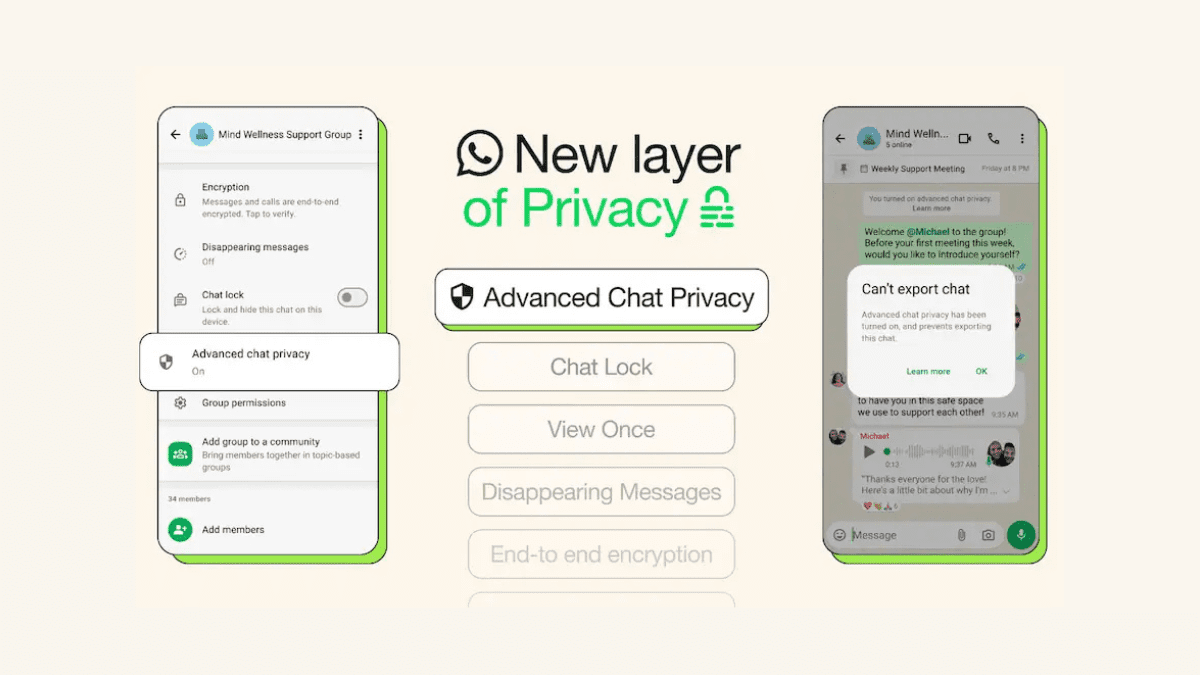
WhatsApp just dropped a new privacy setting that might give you a little more peace of mind — especially if you’re navigating sensitive group chats or sharing information you don’t want leaving the app. The feature, dubbed Advanced Chat Privacy, offers users the ability to block others from exporting chat content, auto-downloading media, or using messages with AI-powered features.
It’s not a game-changer, but it’s a step in the right direction for a platform that’s been steadily trying to shake off past concerns about privacy, particularly in group settings where not everyone is on a first-name basis.
“This new setting available in both chats and groups helps prevent others from taking content outside of WhatsApp for when you may want extra privacy,” the company said in a statement.
The feature is optional and available to anyone on the latest version of WhatsApp. Once toggled on, it acts as a digital fence: blocking exports, preventing media from being auto-saved to someone’s gallery, and disabling content being fed to third-party AI tools — a quiet nod to growing concerns about how AI might mishandle private messages.
That said, don’t confuse this with full lockdown. Users can still manually screenshot or download content the old-fashioned way. In other words, it deters casual over-sharing, but won’t stop someone who’s determined.
WhatsApp admits the feature is “best used” in conversations where trust isn’t a given — think community groups, event planning circles, or large professional chats. And given the rising anxiety around data misuse, it couldn’t come at a more relevant time.
Context Matters — Meta’s EU Woes
The timing of this launch is interesting, especially as WhatsApp’s parent company Meta finds itself squarely in the EU’s regulatory crosshairs. Just this week, the European Commission fined Meta €200 million for violating the Digital Markets Act (DMA), citing the company’s controversial “pay or consent” model. Under this setup, users either fork over cash for an ad-free experience or allow their data to be tracked for personalized ads — with no middle ground.
“This model is not compliant with the DMA,” the Commission said, “as it did not give users the required specific choice to opt for a service that uses less of their personal data but is otherwise equivalent.”
Meta’s response? Defiant, as expected. Joel Kaplan, Meta’s Chief Global Affairs Officer, called out what he described as regulatory double standards.
“The European Commission is attempting to handicap successful American businesses while allowing Chinese and European companies to operate under different standards,” he said. “And by unfairly restricting personalized advertising, the Commission is also hurting European businesses and economies.”
To be fair, the €200 million fine only covers the period between March and November 2024 — the EU is still reviewing Meta’s newer “light tracking” ad model launched late last year. More penalties could follow if the new system also fails to pass muster.
The Bigger Picture
WhatsApp’s Advanced Chat Privacy feature is the latest move in a broader industry shift toward re-establishing trust with users. While it doesn’t offer full-proof protection (you’ll still have to trust people not to screenshot), it acknowledges an uncomfortable reality: sometimes, private conversations are anything but.
And with regulators breathing down Big Tech’s neck, these incremental privacy upgrades aren’t just user-friendly — they’re politically strategic.
Whether that’s enough to keep WhatsApp ahead of the privacy curve remains to be seen. But for now, it’s another checkbox for privacy-conscious users — and a subtle reminder that your messages are only ever as secure as the people you’re chatting with.


