



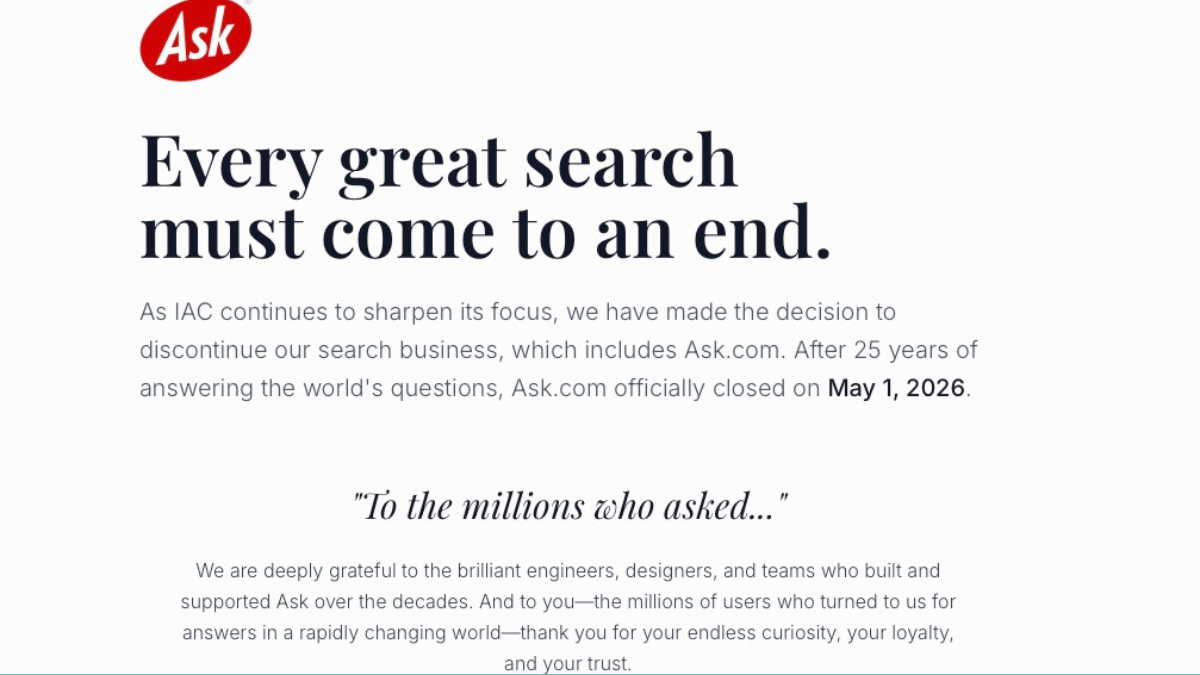
The internet’s original “assistant” just got shown the door, and this time it’s for good. After 25 years of trying to answer our questions, Ask.com, better known as Ask Jeeves, is officially done.
Let’s be honest, it’s been fading for a while.
Before Google took over search and turned itself into a reflex, Jeeves had a genuinely different idea. You asked a question like a normal person and it tried to answer you. No keyword hacking, no gaming the system, just ask and hope for something useful.
It was a smart idea, just not built for what the internet became.
Because what followed wasn’t charm or personality, it was scale. Massive, relentless, data-driven scale, and Ask never really caught up.
InterActiveCorp confirmed the shutdown this week as part of a broader shift in focus. That usually means one thing, the numbers no longer make sense. The site officially went dark on May 1, 2026, and for most people it barely registered.
That’s the part that hits.
For those of us who grew up on dial-up, especially here in South Africa, Jeeves was part of the early internet experience. It was slower and often wrong, but it felt more human. There was a sense that someone, or something, was actually trying to help you figure things out.
Today everything is faster, smarter, and far more efficient. It’s also a lot less personal.
Ask.com now joins the long list of fallen internet names like AltaVista and AIM. The pattern never really changes. In tech, nostalgia doesn’t carry weight for long. Relevance does.
Here’s the twist. The core idea behind Jeeves, letting people ask real questions in plain language, is exactly what today’s AI boom is built on. The difference now is power, data, and companies that can actually execute at scale.
Jeeves didn’t fail because the idea was wrong. It just couldn’t keep up with where the internet was going.


