




In a recent interview aired on Israeli television, Gal Gadot revealed her belief that external political pressures played a role in the disappointing box office performance of Disney’s Snow White (2025) reported Deadline. She expressed her disappointment that what she had hoped would be a major hit ended up struggling commercially. A result she partially attributes to polarised politics in Hollywood. “There’s pressure on celebrities to speak against Israel … I was disappointed the movie was so affected and it didn’t succeed at the box office,” Gadot said candidly.
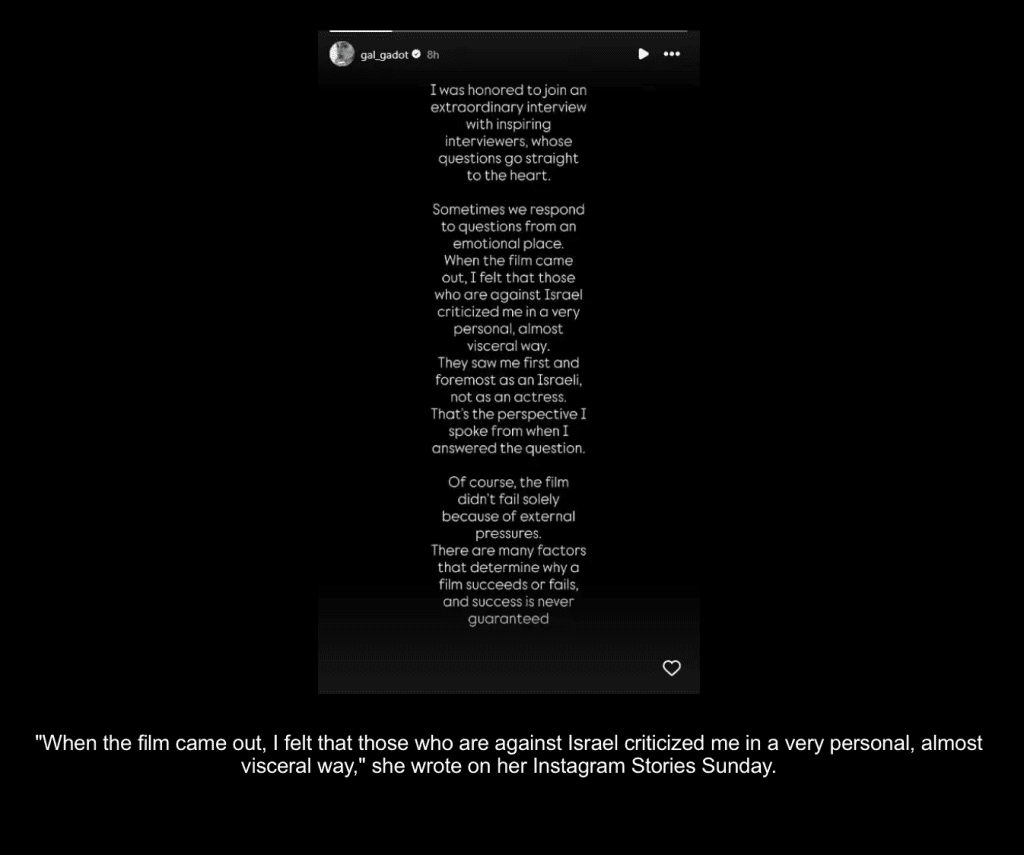
Gadot later addressed her remarks in more depth via Instagram. She explained that her initial statement came from an emotional place, stating that criticism against her often felt deeply personal. She felt that she was being judged not for her acting but for her identity as an Israeli. Nonetheless, she emphasised that Snow White’s box office performance cannot be attributed solely to external pressures. “There are many factors that determine why a film succeeds or fails, and success is never guaranteed,” she wrote.

Snow White was produced on a grand scale, with an estimated production budget ranging from US $240 million to $270 million. It ultimately grossed around $205–206 million worldwide, marking it as a significant commercial disappointment for Disney.
The film generated controversy long before its release. Key flashpoints included:
- Color-blind casting and creative reinterpretations (e.g. depicting the Seven Dwarfs differently), provoking debate and backlash.
- Co-star Rachel Zegler’s outspoken criticism of the original film and her support for Palestine stirred public debate and contrasted sharply with Gadot’s support for Israel.
- The film received mostly negative reviews, citing weak CGI, uneven performances (especially Gadot’s), and storytelling choices that failed to resonate with modern audiences.
- Additionally, boycotts, production delays, and social-media backlash heightened the pressure on the film to overcome more than just storytelling issues.
A Variety report even highlighted how tension between Gadot and Zegler during promotion added to the film’s challenges, prompting broader discourse on how celebrities’ political identities can influence the fate of a project.
Gal Gadot’s perspective highlights one dimension of the film’s struggles: the way geopolitical tensions and public expectations can influence both what artists say and how their work is received. But she also makes clear that the film’s underperformance was not solely due to those pressures, it was a culmination of creative, commercial, and cultural factors.
The controversy-ridden path taken by Snow White underscores the difficulty of bringing classic stories into a modern, politically charged world. A feat that requires not just technical or artistic talent, but also cultural navigation.


