

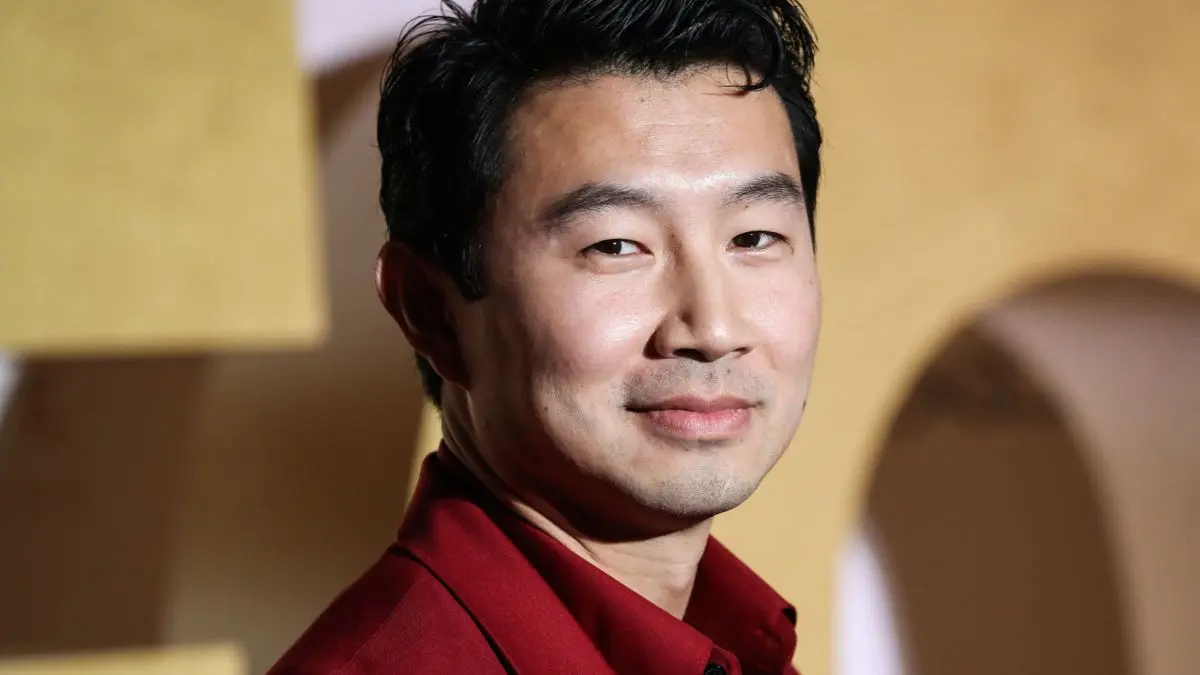
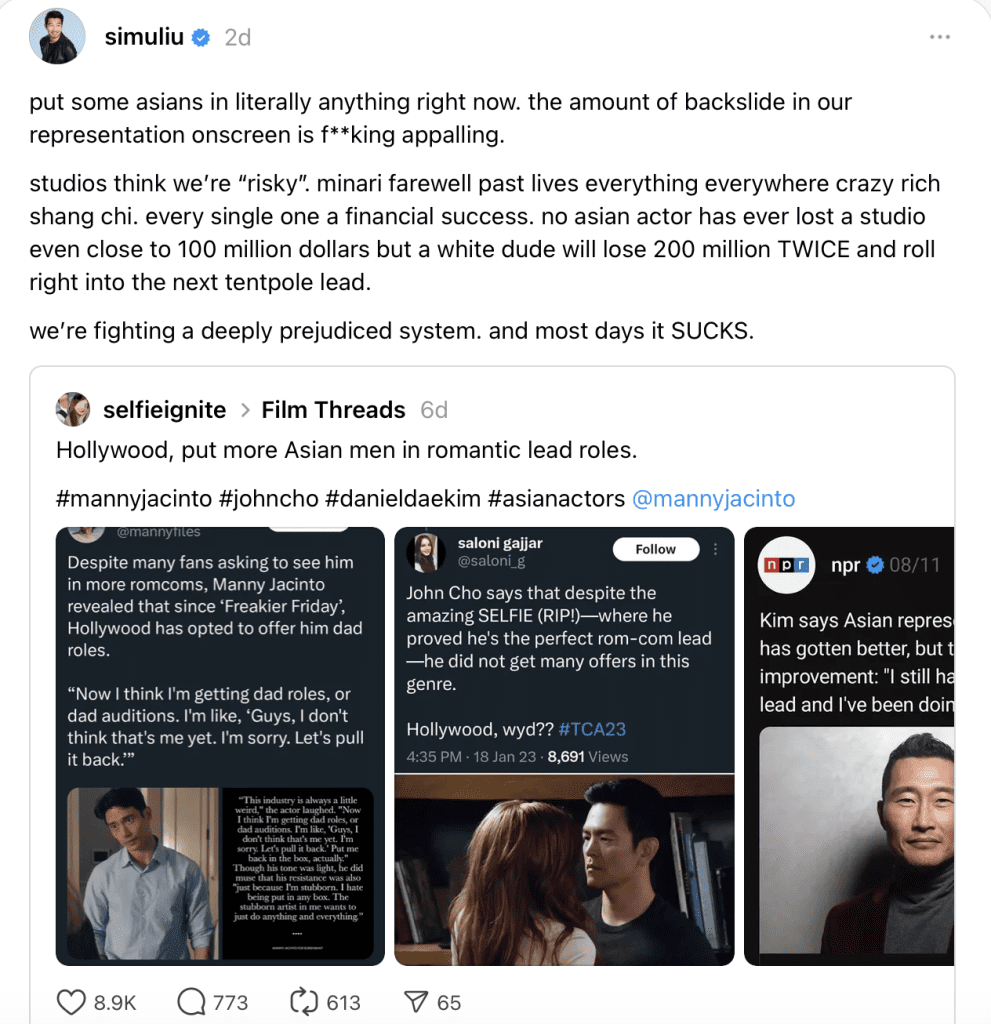
Simu Liu recently used his platform to drop a truth bomb about Hollywood’s chronic failure to represent Asian actors, not as background caricatures but as real leads. In a social media post he wrote, “Put some asians in literally anything right now. the amount of backslide in our representation onscreen is …. appalling,” adding that studios still think Asian talent is “risky.” Liu shared on Threads.
Liu pointed to undeniable successes such as Minari, The Farewell, Everything Everywhere All at Once, Crazy Rich Asians, and his own film Shang-Chi and the Legend of the Ten Rings. These films were not tiny experiments but major financial hits that proved audiences are not afraid of Asian leads.
Yet somehow the industry keeps acting like those victories never happened. “No Asian actor has ever lost a studio even close to 100 million dollars,” Liu wrote, “but a white dude will lose 200 million twice and roll right into the next tentpole lead.” In his words, “we’re fighting a deeply prejudiced system.”
Simu’s frustration comes from more than a few missed opportunities. It is rooted in decades of being sidelined, stereotyped, or erased entirely. Hollywood has spent years reducing Asian actors to sidekicks, villains, or foreigners who exist only to serve the main plot. Even when a story is clearly Asian in origin, studios often reshape it with white leads in the name of “universal appeal.” That is not creativity. It can only be described as erasure.
And even when Asian-led films break through the noise, their impact is treated like a moment instead of a meaningful shift. Success does not automatically convert into future opportunities. Asian actors are still treated as exceptions rather than part of the natural fabric of storytelling. Simu’s call is a demand for the industry to start treating Asian talent as real, multidimensional artists who can lead, love, fail, grow, and captivate audiences exactly the way any other actor can.
Representation is not about diversity points. It is about letting people see worlds that reflect real life. Asian leads are not a niche. They are human beings whose stories deserve the same range and depth that Hollywood freely gives to everyone else. The success of films like Minari, Everything Everywhere All at Once, Crazy Rich Asians, and Shang-Chi did not come from tokenism. They succeeded because they told stories with heart, truth and deep cultural honesty. Audiences connected with the humanity of the characters, not the stereotype. Simu’s frustration is not bitterness. It is a refusal to accept a system that pretends progress has been made when the numbers say otherwise.
Representation shapes identity. When young Asian viewers see someone who looks like them lead a story, fall in love, save the world, or simply exist without being exorcized or mocked, it changes something inside them. It tells them they belong. It tells them they are not invisible. When Simu speaks up, he isn’t just talking to studio executives. He is speaking to every kid who grew up seeing themselves only as the side character. His message is powerful because it is a reminder that stories should mirror the world we actually live in.
If Hollywood listens, we will see fewer Asian characters used as background decoration and more taking their rightful place as central figures. We will see stories told by Asian writers, directed by Asian filmmakers, and carried by Asian performers who are treated as full humans rather than “diversity hires.”
Simu is not complaining. He is pushing. Pushing for long-term change, not trending hashtags. Pushing for a future where “Asian lead” is no longer a unique event but simply another role in a vast landscape of stories. Because until that happens, the fight continues. And in Simu’s words, we are still confronting a “deeply prejudiced system.” But systems can be rewritten, rebuilt and replaced. And with enough pressure, they must.
