


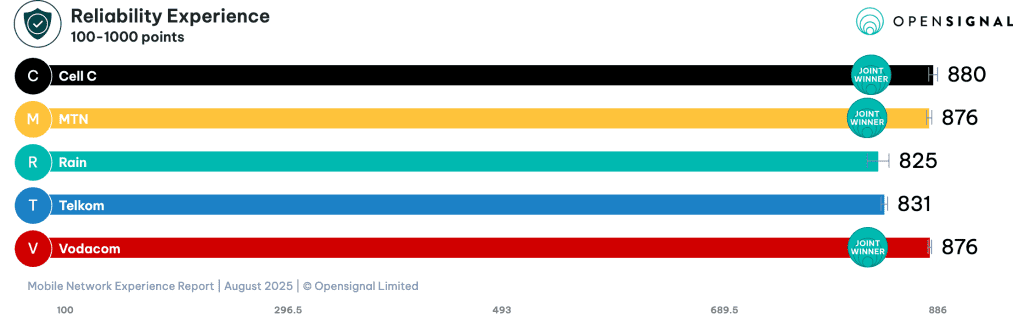
When I read the press release that Cell C has, for the first time, been ranked Joint #1 for network reliability in South Africa, I paused. Not because Cell C has never had its wins, but because reliability was never the word you’d usually associate with them. For years, Cell C has been that network you joined because it was cheaper, or offered a deal you couldn’t refuse, while friends warned you about dropped calls or weak signal.
And yet, here we are. Independent data from Opensignal says Cell C now delivers reliability on par with the country’s biggest players. Add to that joint wins in video and voice app experience, and suddenly, the network people laughed at is being taken seriously.
It got me thinking: maybe we’ve underestimated Cell C’s fight.
Why Reliability Matters More Than Speed
We all talk about speed, but in reality: reliability is the real currency. What matters most is not whether your network can hit 100 Mbps on a good day. It’s whether you can rely on it to stay connected everyday: when you’re submitting that online assignment, processing a customer’s card payment, or video-calling your grandmother.
This is what Cell C’s recognition represents. It’s not just about the numbers, but a shift in trust. The kind of shift that touches people’s daily lives in ways they may not even stop to think about—until the day the call drops, the stream freezes, or the payment fails.
A Shortcut That Works—For Now
Cell C’s climb comes down to a clever strategy. Instead of trying to outspend Vodacom and MTN in building towers, it went with a dual MOCN model, effectively sharing access to more than 28,000 towers nationwide. A smart move that saved money and keeps customers connected.
But I can’t help but think of it like renting instead of owning your home. It works, and it works well, but you’re always aware that you don’t control the foundation. What happens when demand surges, and 5G isn’t just a buzzword but a necessity? What happens if the cost of leasing that space rises?
Right now, it’s a strategy that levels the playing field but tomorrow, it could become the ceiling.
Progress With Footnotes
The joint #1 in video experience matters. We live in a video-first world, where entertainment, education, and work are all streaming-based. To be recognised here is to say: “We can keep up with how people actually live.”
Voice app experience matters too, especially in South Africa where WhatsApp is more common than regular voice calls. Clearer calls on WhatsApp or Teams means better chances for a side-hustler to close a deal, or for a student to join a study group without sounding like they’re speaking from a cave.
However, context matters. Spectrum holdings and backbone capacity still favour the big two. Cell C has narrowed the gap yes, but there’s still a long road ahead before people forget its patchy history.
The Bigger Picture
South Africa’s mobile market is shaped by inequality. For many, data is a lifeline and not a luxury. The ability to connect, learn, earn, and stay in touch with loved ones is deeply tied to reliability. That is why this recognition feels bigger than a corporate marketing headline.
If Cell C can truly deliver on reliability, it brings competition where it is needed most. It means affordable options no longer come at the cost of trust. It means the student in a township, the small business in a rural town, or the parent hustling between jobs can expect their network to show up when it matters.
My Take
Cell C’s achievement here is more than just a technical win. It reminds us that underdogs can rise when they stop trying to play the same game as the giants and instead find their own way forward.
But the victory can be a bit fragile. The MOCN model may be efficient but it suffers from dependency. Spectrum is limited and perceptions are stubborn. But maybe, just maybe the story of Cell C is starting to be rewritten.
To me, this moment is not about Cell C suddenly becoming the best network in South Africa. Rather, Cell C is proving that it belongs in the conversation again. And for a brand that has been written off so many times, that is no small thing.
