

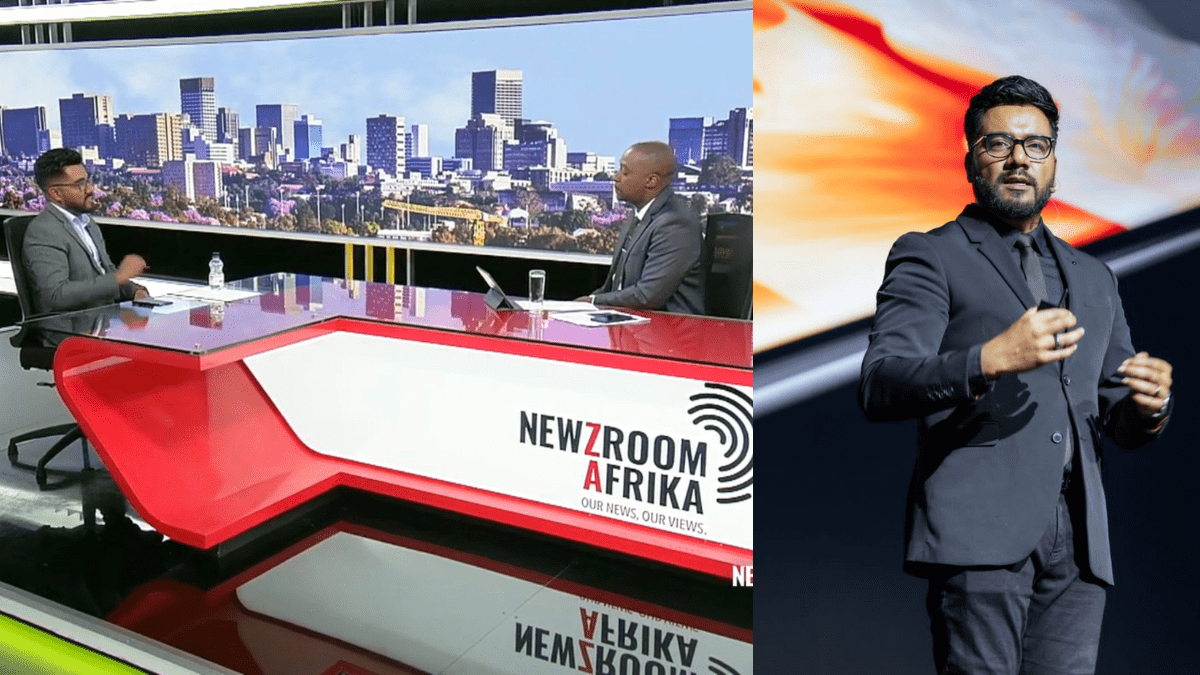
Introducing: The Diary Of A Recovering Suit
This is the first installment in a regular series documenting the shift, the spin, and the soul of the smartphone industry—viewed through the lens of two decades in the tech industry and a newfound life on the other side of the stage.
For many years, I was the executive in the spotlight, often peddling the corporate narrative with a practiced smile. It’s a background that gives me a superpower most tech journalists don’t have: I can spot the marketing B.S. before the presenter even clicks the first slide. I know how the boerewors is made, which makes the current state of the smartphone industry particularly amusing to watch.
Inside every smartphone launch at some posh Joburg venue, the air usually hums with the practiced vibrations of corporate optimism. The spectacle of the event often given much more thought than the product itself. On stage, a local executive gestures toward a massive screen dominated by two letters that have become the industry’s universal shorthand for please buy this: AI.
The Salvation Pitch
For the better part of the next hour (if you’re lucky), the pitch is less about real innovation but rather sounding more like they’re about to bring us salvation. We are told this slab of glass is no longer just a phone; it is your “creative partner,” your “personal concierge,” and an engine of pure, unadulterated productivity.
Then, the lights come up and you get your hands on the device. Suddenly the “revolution” looks suspiciously like the 2023 model with a slightly different camera bump.
To understand why the industry has pivoted so violently toward Artificial Intelligence, you have to understand the quiet desperation currently gripping the global hardware hubs. The “Slab Era” has reached a terminal plateau. For about a decade, the recipe was simple: better cameras, thinner bezels, premium materials, faster processors. But we’ve reached a point of diminishing returns where the human eye can’t really tell the difference between “very fast” and “slightly faster.”
In the absence of hardware breakthroughs, the industry has turned to a much older trick: Narrative.
The Shared Brain Problem
The irony, of course, is that most of this “magic” isn’t even theirs. It doesn’t matter if it’s a launch in Seoul or Johannesburg, the features being demoed—the real-time translation, the “circle-to-search” tricks, the generative photo editing—almost always lead back to Google’s Mountain View headquarters.
Brands are essentially taking the same foundational models, wrapping them in a proprietary coat of paint, and presenting them as if they’ve split the atom in their own backyard. It’s a game of musical chairs where everyone is claiming the same seat.
The demo ofcourse turns the AI into a wizard. It scrubs a stray tourist out of your background shot of Table Mountain with a flick of the finger and takes your rambling voice note and turns it into a bulleted list that makes you sound like a McKinsey consultant.
The Reality Gap
But out in the wild on the streets of Joburg or the offices of Cape Town, the wizardry often stutters.
- Digital Ghosts: Generative fills leave behind textures that don’t exist.
- The Accent Barrier: Transcription engines, trained on the flat vowels of Northern California, often stumble over the melodic cadence of a South African accent.
This creates a Trust Gap. For a tool to be useful, it has to be invisible. You don’t double-check a light switch to see if it worked. But with current smartphone AI, users find themselves constantly auditing the output—correcting the “corrected” email or squinting at the “enhanced” photo. Instead of removing friction, the tech introduces a new kind of cognitive tax. And that is before we even begin to explore the implications of imported intelligence—not understanding the South African context to be in anyway truly useful.
The Hype Cycle
The industry has been here before. We’ve been sold the “transformation” of 5G, 4K, and 3D screens—all technologies that eventually settled into the background once the hype ran out of oxygen. AI will likely follow the same path. The features that actually matter, the ones that save you time on a search or help you find a photo of your dog will stay. The features that will actually make you more productive at work and learning will come. But the theatrics will fade.
Until then, we are stuck in the performative phase. We will continue to sit in posh venues, watching pretty marketing slides, and listening to tech execs promise us the future.
But as the presenter tucks that new shiny device back into their pocket and the applause fades, the reality remains: The hardware has been standing still for some time, and the software is still trying to learn our names. We’re just paying more for the privilege of being the test subjects.
