

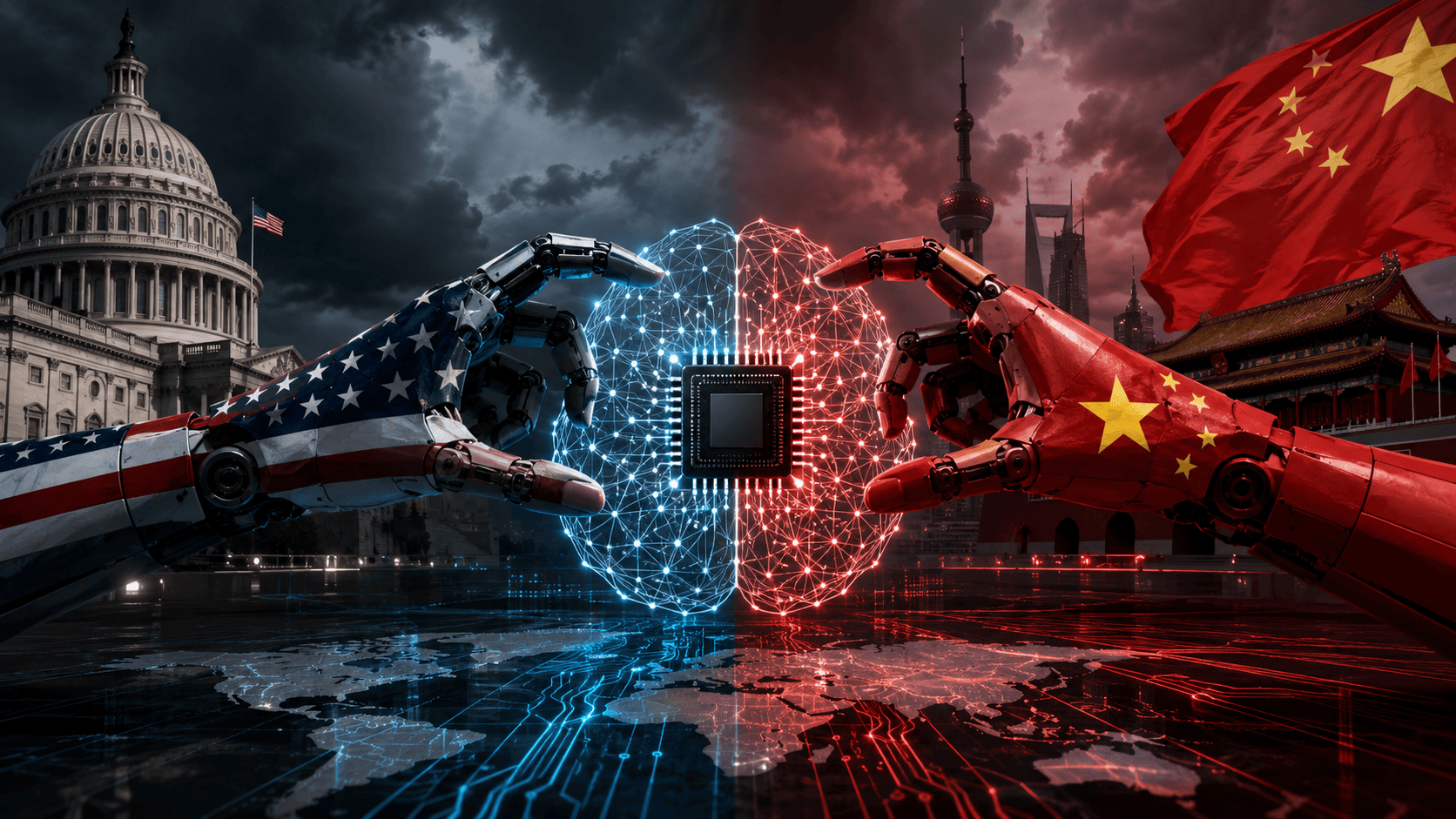
China has accused the United States of “AI hegemonism” and warned of countermeasures, after senior US officials floated investigations, sanctions and trade restrictions against Chinese AI developers accused of copying American models.
The commerce ministry said on Monday that Washington was threatening Chinese firms with punishment over allegations they had used “distillation” to replicate advanced US systems, a charge the ministry said rested on neither factual nor legal grounds. A ministry spokesman warned that for any action causing what he called substantive harm to Chinese interests, Beijing would take all necessary measures to safeguard its rights, the sort of formulation that tends to precede an actual response rather than describe one.
Distillation itself is not exotic. It is a widely used training technique in which the outputs of a stronger model are used to train or sharpen a weaker one, and it happens across the industry every day. The US position, at least as officials have framed it, is that there is a line between ordinary distillation and industrial-scale extraction that amounts to intellectual property theft, and that Chinese developers have crossed it.
At the centre of the dispute sits Moonshot AI, the Beijing-based developer whose recently released Kimi K3 model has drawn attention for its coding ability. The model has reopened a familiar debate in Washington over whether Chinese labs are copying US systems or simply closing the gap through their own research, an argument that played out in almost identical terms last year when the startup DeepSeek burst into view.
Michael Kratsios, who directs the White House office of science and technology policy, said last week the US government held information indicating Moonshot had distilled Anthropic’s Claude Fable 5 model to build Kimi K3. Kratsios alleged the company had stood up a sophisticated internal platform to run large-scale distillation and rotated between multiple access methods to avoid detection, and that it had obtained servers fitted with Nvidia’s GB300 chips, reportedly reaching such systems in Thailand to train its models.
Treasury secretary Scott Bessent went further, warning that Chinese companies could face financial sanctions or a place on the commerce department’s Entity List, the trade blacklist that restricts access to US technology. “We support open-source AI and the innovation it unlocks. But open source is not open season on American IP,” Bessent wrote on X, adding that covert, industrial-scale distillation crossing into theft would put sanctions and Entity List designations on the table.
Moonshot has rejected the characterisation. The company told China’s National Business Daily last week that Kimi K3’s gains came from original changes to its underlying architecture rather than from copying anyone, which is roughly the answer one would expect and not, on its own, evidence either way.
The stakes for Moonshot are not abstract. Placement on the Entity List could sharply restrict its access to US semiconductors, software and cloud services, the same mechanism Washington used against Huawei from 2019 onward, with results the Chinese telecommunications giant is still living with. For a young AI lab dependent on foreign chips and tooling, the designation would function less as a warning than as a wall.
There is also a paper trail. Anthropic said in February it had identified more than 3.4 million interactions with its Claude models linked to Moonshot, and that hundreds of fraudulent accounts had been used to probe capabilities including reasoning, coding, data analysis, tool use, computer vision and the operation of computers. None of that has been tested in a courtroom, and it may never be, but it is the kind of detail that turns a diplomatic spat into an enforcement case.
Source: Reuters
