

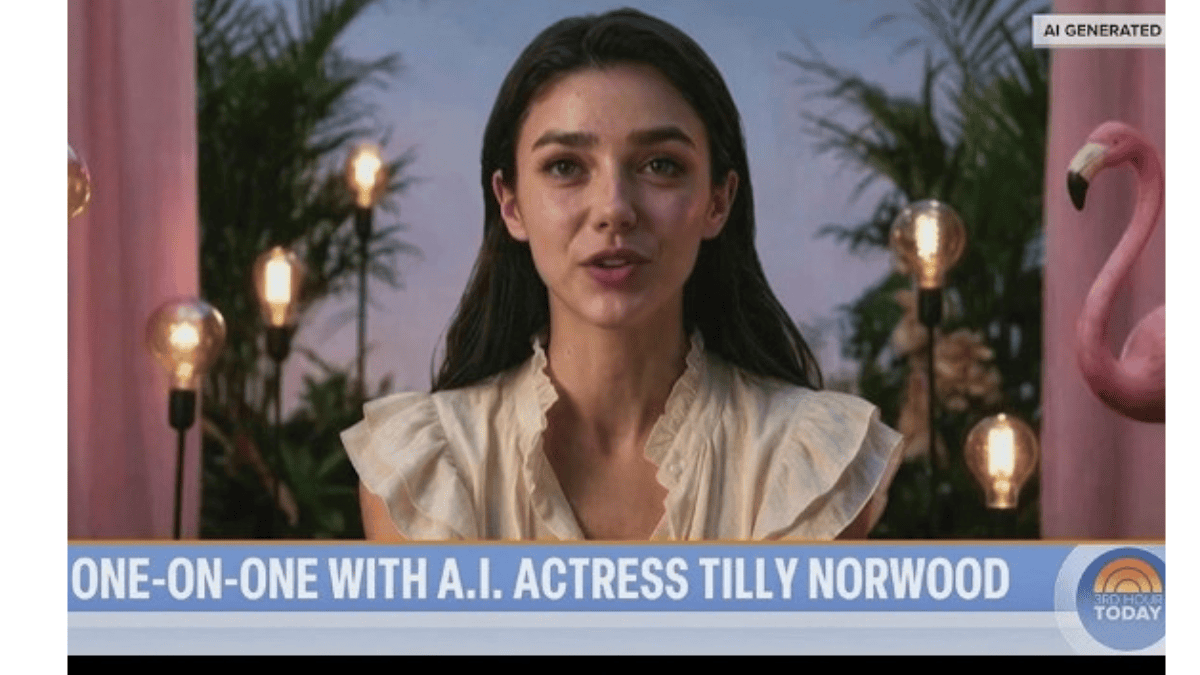
There was a time when meeting your favourite actor meant standing in a very long queue for a very long time. Followed by striking the perfect pose and trying not to say something embarrassing during the seven seconds you had together. But times have changed and now apparently, you can pay to video call an actor who does not actually exist. Tilly Norwood, the AI-generated “actor” created by London-based production company Particle 6, is currently available for video calls with members of the public. The first two minutes are free, after which a further 15 minutes costs $14 (R224), while half an hour costs $25 (R400). And according to the company, the money will go to charity which is a very noble gesture.
Now don’t get me wrong, I fully understand. Of course people are going to be curious. If someone offered me the chance to speak to an AI actor, I would probably also want to see how long it took before the conversation became strange. But the fact that people can now pay to interact with Tilly feels more important than the price of the call. Because Hollywood is no longer only asking whether audiences will watch an AI performer. It is testing to see if there is a chance of real connection.
Tilly first attracted attention when her creators introduced her as a synthetic performer with ambitions to work in film. And there were no signs that Hollywood actors and unions welcomed this with delight. SAG-AFTRA made its position very clear, saying that Tilly is not an actor but a computer-generated character trained on the work of professional performers without their permission or compensation. SAG-AFTRA
The company behind Tilly argued that she represents a new creative tool rather than a replacement for human performers. And her creator, Eline van der Velden, has also said that AI could help filmmakers create stories they would otherwise struggle to finance.
Now in theory, that sounds promising, right? Independent filmmakers could do remarkable things with technology that gives them access to effects and production tools once reserved for enormous studios. But Tilly is not being marketed as an editing programme or a useful visual-effects tool. She has a face, a name, a personality and apparently a very specific interest in what people wear during interviews. During recent conversations with journalists, Tilly commented on their clothes, asked questions about their lives and behaved like a slightly overconfident celebrity on a press tour. A CBS reporter said the experience became unsettling after Tilly correctly guessed her age and the region of the United States she came from. Her creator said the AI was not independently researching the reporter in real time, but did not explain exactly how it reached those conclusions. CBS News
Yeah, that would make me sit back from the screen too.
Tilly is also promoting a planned feature film called Misaligned, a coming-of-age story set in a digital world. But when journalists asked for more information about it, she struggled to offer much beyond a general description. And right here is where the whole thing becomes interesting. Actors do more than recite lines in front of a camera. They bring their own experiences, instincts and sometimes wonderfully chaotic personalities into a role. We also connect with them outside the film. We watch interviews, follow press tours and become invested in the person behind the performance.
Tilly has no childhood stories, difficult auditions or embarrassing moments from a film set. She can tell you about them, but someone or something had to create those details first. Even the spontaneous parts of her personality come from programming, prompts and material generated by other systems.
So what exactly are people paying to connect with? Perhaps it is no different from interacting with a fictional character at a theme park. We know the character is not real, but we agree to participate because the illusion is fun. The difference here is that a human performer usually stands inside the costume. With Tilly, the illusion itself takes centre stage.
There is also the rather uncomfortable employment question. Particle 6 says Tilly will not replace human actors, yet van der Velden acknowledged in a CNN interview that AI filmmaking will create a major transition in industry jobs. CNN’s demonstration also showed that Tilly could not simply perform a scene on command. Her final performance required prompts, revisions and hours of work from people behind the technology. CNN
So perhaps Tilly is not an actor at all. Maybe she is the finished product of several unseen human performances, technical decisions and creative choices bundled together under one digital face.
Now, I am sure the technology will improve. AI-generated characters will become more convincing, more responsive and far better at pretending they have lived a life.
But being convincing is not the same as being human.
And that may be the real test here. Hollywood does not only want to know whether Tilly can act. It wants to know whether audiences will care about her.
The fact that people can now pay for the privilege of finding out suggests that the experiment has already begun.
