

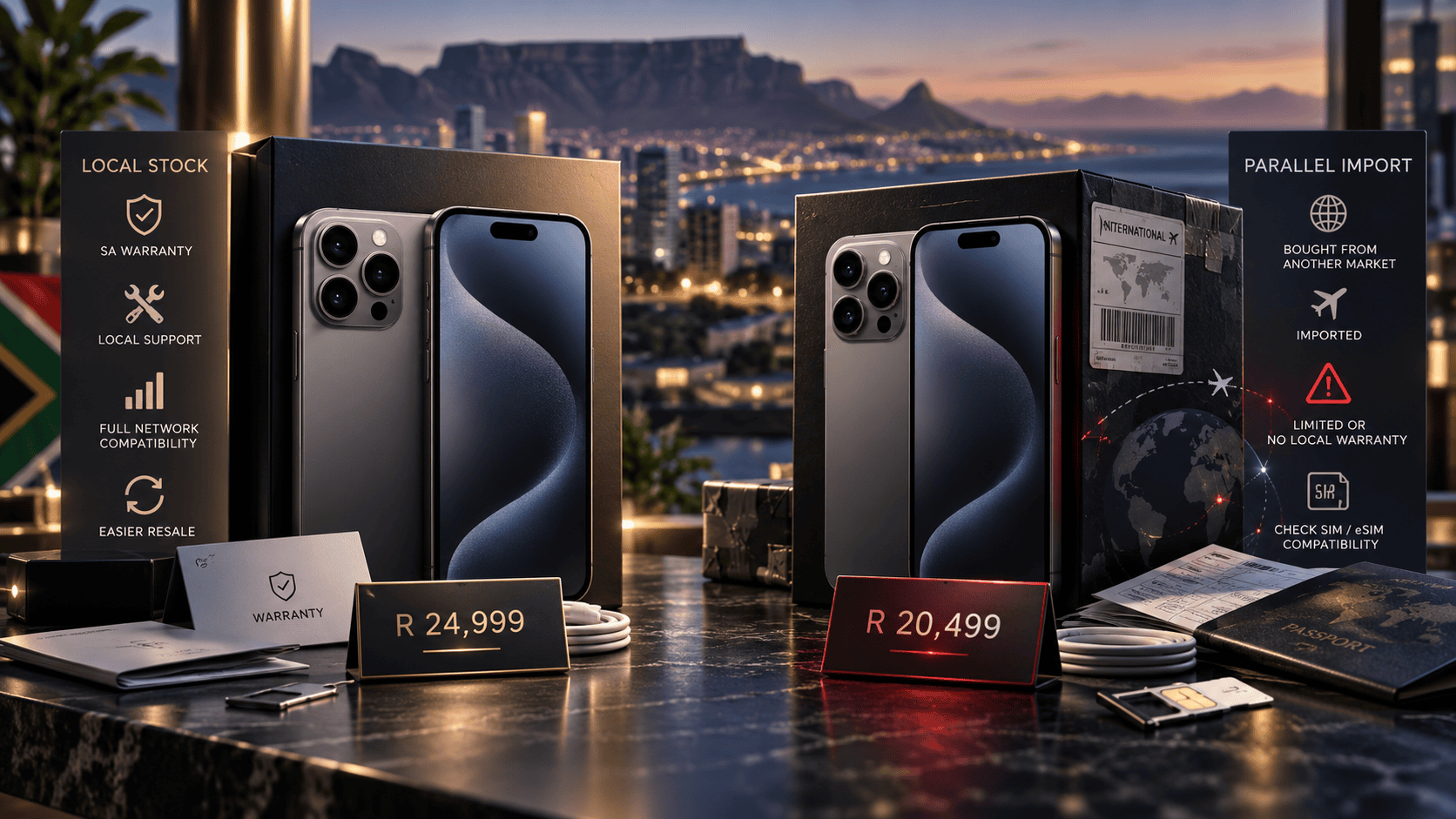
Search for almost any flagship phone in South Africa right now and you will find two prices for what looks like the same box. One is the local price. The other is a few thousand rand lower, often from a seller you have never heard of, with a small line somewhere saying “parallel import” or “international version”.
Rising memory costs have pushed device prices up across the continent, and MTN and Vodacom said in June 2026 that several manufacturers had raised prices, cut specs or pulled models. When the official price climbs, the grey alternative looks more tempting.
Whether grey is worth it comes down to the device, the seller and how much risk you can live with.
What a parallel import actually is
A parallel import, or grey import, is a genuine product made by the real brand. It was simply bought in another market, such as the UAE, Europe, Hong Kong or the US, and brought into South Africa outside the brand’s official local distribution channel. A grey phone is not a fake, and it is not stolen.
It is also legal in South Africa. Section 34(2)(d) of the Trade Marks Act allows parallel importation, and local courts have generally held that brand owners cannot block genuine goods that were lawfully sold elsewhere.
The law however does require full disclosure. Section 25 of the Consumer Protection Act requires anyone selling grey goods to display a clear notice that the authorised local importer will not honour the warranty. A seller who leaves that out is breaking the law.
Whoever sells you the phone in South Africa is still bound by the CPA’s six month implied warranty on defective goods, so a fault in the first six months is the local seller’s problem to sort out.
The case for buying grey
Price. For most buyers, this is what draws them to grey stock. Grey sellers buy where the device is cheapest and skip the costs the official channel carries, like local marketing, service centre networks and bundled extras. On a flagship, the saving can run into thousands of rand.
Sometimes it is the only way in. Some brands simply do not sell here. Google has never officially launched its Pixel phones in South Africa, and buyers have relied on grey sellers and overseas shipping since the first model. OnePlus has no official local presence either. If you want a Pixel for its camera and clean Android, or a OnePlus for its charging speeds, a parallel import is your only option. Every drawback below still applies, so the checks at the end matter even more.
Early launches and missing variants. New phones often land overseas first, and some colours, storage sizes or models from brands that are sold here never get an official South African release. If you want something specific, grey may be the only way to get it.
Dual SIM variants. Some international versions offer SIM configurations that the local model does not. For people who juggle a work and personal number, that can matter.
It is the real thing. A genuine grey unit comes from the same brand and the same factories. In most cases the phone in your hand performs just like the local version, although regional models can differ in chipset, network bands or features, which I cover below.
The case against
The brand warranty usually stays behind. Local distributors generally will not repair a device that was meant for another market. Samsung South Africa has said in the past that warranties are void when a grey unit is taken to a service centre, and Apple’s local distributor has said the same about iPhones not intended for this market. Many grey sellers offer their own warranty instead, so check who is behind it.
You lose the local extras. Official stock often comes with screen damage cover, trade-in deals, bundled accessories or network promos. A grey unit gets none of that.
Repairs. This is where a grey phone costs you most.
- No walk in service network. Buy local and you can usually walk into an authorised service centre in most major towns. A grey phone’s warranty runs through the seller, which often means one drop off point or a courier. If you live in Polokwane and the seller is in Joburg, your phone gets couriered.
- Spare parts are not a given. Authorised repairers order parts against local model numbers. A regional variant may need parts that are not stocked here, so even a repair you pay for can take weeks.
- No guarantee of original parts. Many grey owners end up at independent repair shops. Some are excellent. Others fit cheap aftermarket screens and batteries with poorer brightness, touch response, colour or battery life. Newer iPhones flag non genuine screens and batteries in Settings, features like True Tone can stop working, and water resistance is rarely restored to factory standard.
- Courier costs and downtime add up. Sending a phone back to the seller, or overseas, costs money both ways, and you are without your phone while it is gone. Budget for at least one repair trip as part of the real price.
The eSIM trap. Apple now sells eSIM only versions of the iPhone 17, 17 Pro and 17 Pro Max in 12 markets, including the US, UAE, Saudi Arabia and Qatar, which are common grey sources. The iPhone Air has no SIM tray anywhere. Our networks do support eSIM, but if you rely on a physical SIM, or swap SIMs often, check the model before you pay. Units meant for mainland China go the other way, with physical SIM only and no eSIM.
Tap to pay might not work. The NFC chip is the same, but the wallet software can be locked to the market the phone was built for. Samsung’s own forum moderators have confirmed that Samsung Wallet depends on the device’s intended market. US units ask for a five digit ZIP code that no South African card can satisfy, and a local buyer with an imported S25 Ultra was told Samsung Wallet isn’t supported on the phone at all. Google Wallet is the usual workaround on Android, but test it before you leave your bank card at home. On cheaper models, check the exact variant, because not every market’s version ships with NFC.
Network bands and calls. Vodacom and MTN run LTE and 5G across the 700, 800, 900, 1800, 2100, 2600 and 3500 MHz bands. The low 700 and 800 MHz bands carry signal into rural areas and buildings, so a model missing one of them may drop to weak signal the moment you leave the city. Voice over LTE and Wi-Fi Calling also depend on firmware and network provisioning, and a phone running another region’s software may not get them. As networks wind down 2G and 3G, that matters more. Ask your network before you buy.
Software differences. Phones meant for mainland China often ship without Google services. Sellers add them afterwards, but Xiaomi has blocked China units from running its global software, so updates and Google apps can be unreliable. iPhones with a model number ending in CH/A cannot use Apple Intelligence anywhere in the world, even if you change the region. Samsung units also get updates on their home region’s schedule, not ours.
Health features. Samsung’s ECG and blood pressure tools need approval as a medical device in each country, and have been tied to the market the watch and phone were sold in. South Africa is approved, but a grey unit from a market that is not may lose them. Samsung says it is moving to account based region detection from July 2026, which may help, but check before you buy a watch for these features.
Small annoyances. Phones from Japan and South Korea have a camera shutter sound you cannot switch off.
Plugs and paperwork. Expect a UK, EU or US plug and an overseas invoice. Some insurers and contract providers want local stock and a local invoice, so check before you assume you can cover the device.
Resale value. When you sell or trade in later, buyers and trade in programmes may offer less for a grey unit, or refuse it outright.
Grey versus local at a glance
| Local stock | Parallel import | |
| Price | Full local price | Often thousands of rand less |
| Who honours the warranty | Brand and its local service centres | The seller, on its own terms |
| CPA six month implied warranty | Yes, against the seller | Yes, against a South African seller |
| Repairs and parts | Walk in service centres, original parts | Courier to seller, parts not guaranteed |
| Local extras (screen cover, promos, trade in) | Usually included | Not included |
| Tap to pay (Samsung Wallet) | Works | May be region locked |
| Network bands and VoLTE | Built and provisioned for local networks | Check the exact model with your network |
| SIM setup | Physical SIM and eSIM | Depends on the source market |
| Software, AI and health features | Full local feature set | Can be missing or limited |
| Charger plug | South African | UK, EU or US |
| Contract and insurance options | Full range | Can be limited |
| Resale and trade in | Easier | Often worth less |
Before you buy grey, check these
- Ask directly, in writing. “Is this official South African stock, and who handles warranty claims?” Keep the reply.
- Get the exact model number. Search it to confirm the source region, SIM setup, NFC and supported network bands. On an iPhone, avoid CH/A models if you want Apple Intelligence.
- Read the seller’s warranty. How long is it, where is the phone assessed, and who pays courier costs both ways?
- Check the seller, not just the price. A registered South African business with a physical address and a track record is worth more than an extra R500 off.
- Confirm it is new and sealed. Grey stock is sometimes refurbished or activated. Check the serial on the brand’s own site.
- Test the essentials straight away. Load your bank card into the wallet, make a call on 4G, and check signal at home and work while you can still return it.
- Price in the risk. Add the cost of one repair trip and a couple of weeks without a phone. If you are still saving money after that, the deal holds up.
- Check your insurer. Confirm they will cover the device with the invoice you will get.
My take
I am not against parallel imports, and there are two cases where I think they make sense. The first is a brand or model that is not sold here. If you want a Pixel or a OnePlus, grey is the only way to get one, and that is a fair trade if you know the risks. The second is a lower cost device you could afford to replace if things go wrong. On a cheaper phone, the saving can be worth the risk.
Outside of those two cases, I would buy local. On a flagship that costs what a decent second hand car once did, local stock gets you a service centre you can walk into, original parts, a warranty the brand stands behind, tap to pay that works and an easier resale when you upgrade. A few thousand rand saved upfront can disappear after one bad repair.
If peace of mind matters to you, buy local, warrantied stock. If you do go grey, know exactly what you are buying, test it the day it arrives, and get the warranty terms in writing.
