

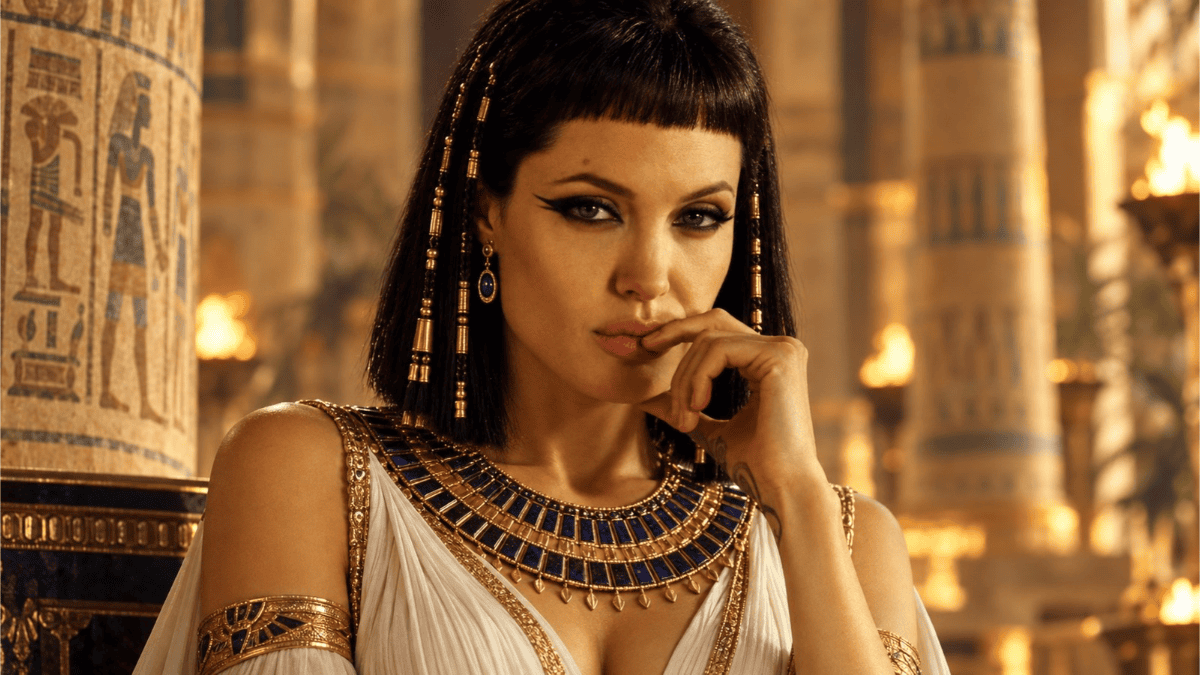
Somewhere in an alternate timeline, Angelina Jolie is standing inside an enormous Egyptian palace while Martin Scorsese tells everyone to do another take. Unfortunately, we do not live in that timeline.
Scorsese has revealed that he nearly directed Jolie in a film about Cleopatra VII. Eric Roth was attached to write the screenplay, years before working with Scorsese on Killers of the Flower Moon. And judging by the director’s description, this was not going to be a quiet historical drama where everyone walks through corridors discussing grain supplies.
“It was gonna be really wild,” Scorsese said.
Now those are dangerous words to use when discussing a film we will probably never see. What was wild about it? Were there enormous battles? Political betrayals? Several people being stabbed during dinner?
Common, we need answers.
Scorsese discussed the abandoned project during the first episode of Tribeca’s Crafty, a new series featuring conversations with filmmakers. He jokingly blamed Seth Rogen and Kim Jong Un for ruining the film. Variety reports that his comments referred to the 2014 cyberattack against Sony Pictures, which followed the controversy surrounding The Interview.
That film starred Rogen and James Franco as journalists recruited to assassinate North Korean leader Kim Jong Un. North Korea strongly objected to the comedy, and hackers later released thousands of Sony emails, documents and private conversations. So yes, in one of Hollywood’s stranger chains of events, a comedy about killing Kim Jong Un may have helped prevent Angelina Jolie from playing Cleopatra in a Martin Scorsese film.
Try explaining that sentence to somebody in 2013.
Of course, Rogen did not personally cancel Cleopatra. Scorsese was clearly joking. But the Sony hack created a rather complicated situation around the project. Among the leaked emails was a message in which producer Scott Rudin called Jolie a “minimally talented spoiled brat” during an argument over another film. I most certainly cannot imagine that email improved the working relationship.
The hack did more than expose some embarrassing conversations. It revealed salaries, disputes, private opinions and business plans that people at Sony never expected the public to see. Projects became attached to arguments happening behind closed doors. And once those doors had been kicked open, returning to business as usual became rather difficult. Which leaves us wondering what Scorsese’s Cleopatra might have looked like.
Hollywood has often portrayed Cleopatra through romance, beauty and her relationships with Julius Caesar and Mark Antony. Elizabeth Taylor’s 1963 version remains the most famous, partly because the production became almost as dramatic as the life it was recreating. But Cleopatra was also a ruler trying to protect Egypt while Rome expanded its power. She understood politics, language and the importance of controlling how people saw her. That sounds like exactly the kind of character Scorsese could have explored.
His films often concentrate on ambitious people operating inside powerful systems. They understand the rules, benefit from them and eventually discover that those systems can destroy them too. Cleopatra attempting to maintain control while Rome closed in would have fitted rather comfortably into that world. And Jolie could have brought something interesting to the role. She has the presence required to play someone who walks into a room already knowing that everybody is watching. But she can also make that confidence feel like armour. Cleopatra would need both.
The project passed through several other famous hands. David Fincher, James Cameron, Paul Greengrass and Ang Lee were all connected to it at different points. Sony later hired David Scarpa to rewrite the screenplay, while Denis Villeneuve reportedly entered talks to direct in 2017. More recent reports have linked Villeneuve and Zendaya to another possible version, although nothing has moved into production.
Perhaps Hollywood will eventually return to Cleopatra. It has never been particularly good at leaving famous historical figures alone. But Scorsese’s version now belongs to that fascinating collection of films that almost existed. The director was ready. Jolie was going to play the queen. Roth was writing the screenplay. Then a comedy annoyed North Korea, Sony’s private emails landed online and the whole thing disappeared.
Cleopatra survived Rome, political betrayal and more than 2,000 years of people rewriting her story. But even she could not survive the Sony hack.
