

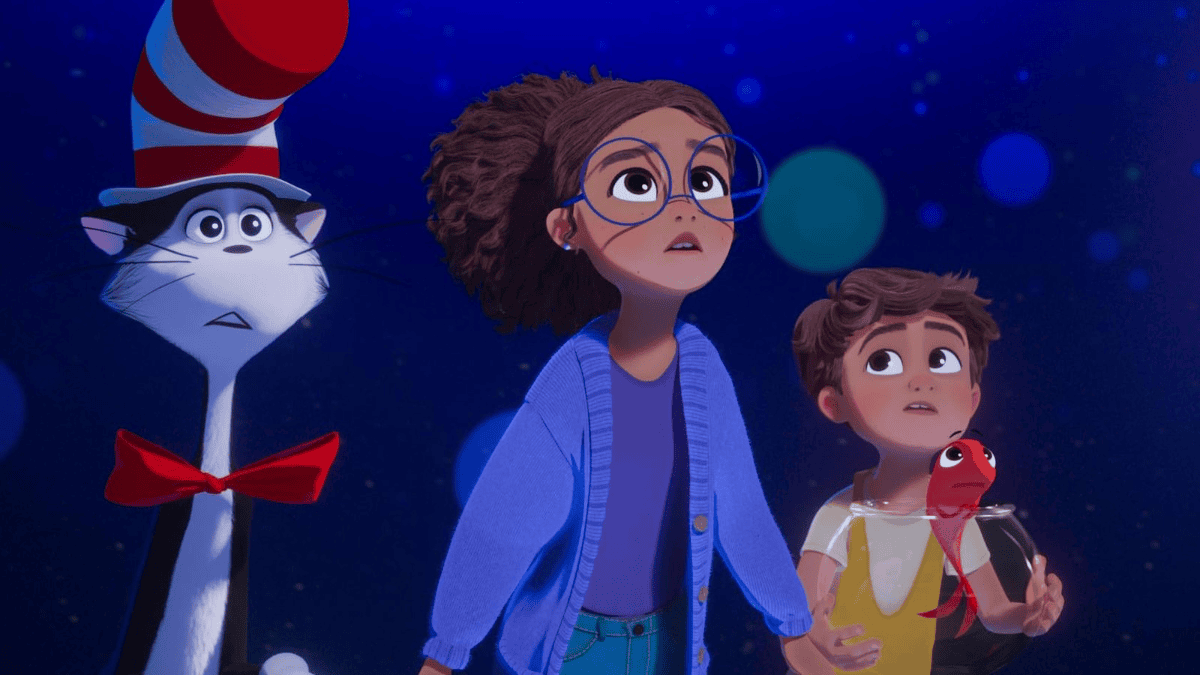
The Cat in the Hat has returned to cinemas. And after what happened the last time, we should probably approach him slowly.
The new animated film stars Bill Hader as the voice of Dr. Seuss’s famous troublemaker. Thankfully, nobody has placed Hader inside prosthetic fur and asked him to smile directly into the camera. The 2003 live-action film already did enough damage in that department. But according to early reviews, the new Cat in the Hat has discovered a completely different problem.
It may simply be trying too hard.
The story introduces the Cat as an employee of the Institute for the Institution of Imagination and Inspiration. Yes, that is quite a mouthful. The organisation sends him to help siblings Gabby and Sebastian adjust to a new town. If he fails, he could lose his magical hat. So the Cat now has a job, an employer and performance targets. Ha, ha, even imaginary creatures cannot escape workplace pressure.
Bill Hader appears to be one of the film’s strongest choices. His voice carries the right mixture of friendliness, mischief and barely controlled chaos. Hader understands how to make a character sound as though he has developed an idea that will either solve everything or destroy the room. But Variety argues that the film surrounds him with far too much story. The review describes the animated adventure as so overstuffed that it begins resembling a Marvel film created for very young children. What a funny, slightly concerning comparison.
The original 1957 book had a beautifully simple idea. Two bored children sit at home on a rainy day. The Cat arrives and creates complete mayhem. Their fish complains. Thing One and Thing Two make everything worse. Then the children must decide whether they can clean the house before their mother returns. That was enough.
The new film expands the story into a much larger world involving a magical institution, different dimensions and an adventure designed to explain where the Cat comes from. The cast also includes Xochitl Gomez, Tiago Martinez, Quinta Brunson, Matt Berry, Bowen Yang, America Ferrera and Giancarlo Esposito. I really don’t think that there is anything wrong with expanding a short children’s book into a feature film. But Dr. Seuss did not write enough material to fill almost two hours, unless the filmmakers planned to make the Cat balance objects for an alarmingly long time. Also, expansion requires restraint.
Modern animated films often appear terrified that children may become bored if the screen remains calm for longer than six seconds. Every corner needs a new character. Every scene needs a joke, chase or brightly coloured object travelling towards the audience. And somewhere near the end, a large emotional lesson must arrive and explain what everyone has learned.
I believe that children deserve exciting films and stories that allow them to breathe.
The Cat is already an interesting character because nobody knows exactly what he will do next. He does not need an entire organisation behind him or a complicated mythology explaining the importance of his hat. The mystery forms part of the fun. He arrives, causes trouble and leaves everyone wondering whether any of it actually happened.
At least this version does seem to understand that the Cat should look like a cartoon. Directors Erica Rivinoja and Alessandro Carloni have placed him inside a colourful animated world where the strange shapes and impossible movements of Dr. Seuss make visual sense. That already gives the film an advantage over the 2003 adaptation, where the Cat looked as though somebody had discovered him behind a nightclub at three in the morning.
The response from critics has been mixed. Several have praised Hader and the voice cast, while questioning whether the film’s enormous adventure captures the simple appeal of the book. The official Warner Bros. site presents the movie as a journey filled with imagination, irreverence and worlds audiences have never seen.
That may be exactly what younger viewers want. Children are not film critics, after all. They may enjoy every noisy second while the adults beside them quietly wonder why the Cat has an employer. But Dr. Seuss made something memorable from a rainy afternoon, two children and one deeply irresponsible visitor.
Sometimes a Cat only needs a hat. He does not need the entire cinematic universe underneath it.
