

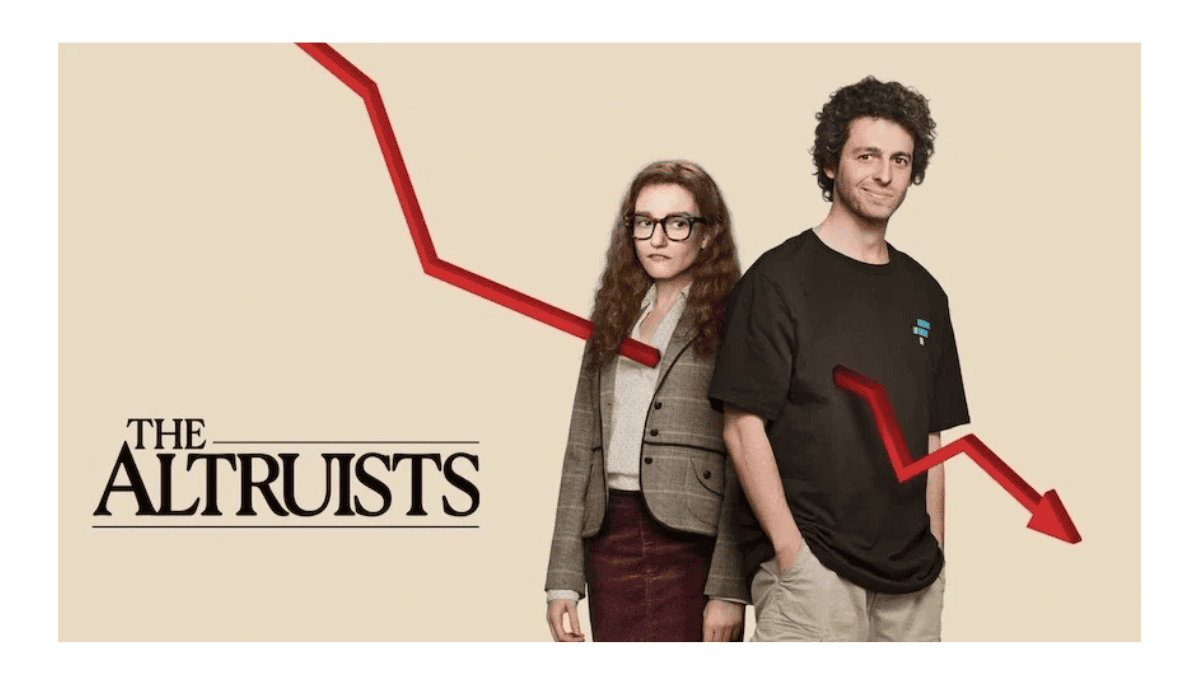
There are toxic relationships. And then there is falling in love with somebody while helping build a financial empire that eventually loses billions of dollars belonging to other people. Netflix’s The Altruists turns the collapse of cryptocurrency exchange FTX into an eight-episode drama about ambition, fraud and two extremely clever people convincing themselves that normal rules no longer apply to them. Anthony Boyle plays FTX founder Sam Bankman-Fried. And Julia Garner portrays Caroline Ellison, his on-again, off-again girlfriend and the head of Alameda Research.
Together, they wanted to change the world.
Unfortunately, quite a few customers probably wish they had chosen a smaller hobby. The series begins near the end, with authorities closing in on the luxury home where Sam built his cryptocurrency empire, which is very clever because now everybody wants the inside story. So the story goes back to when he and Caroline met, became romantically involved and slowly transformed a collection of enormous ideas into one of the most spectacular financial disasters in recent history.
At first, their connection feels almost innocent. Sam and Caroline are brilliant, awkward and far more comfortable discussing mathematics than emotions. They believe that earning enormous amounts of money will allow them to give more away and improve the world. This philosophy, known as effective altruism, sounds admirable until it becomes a very convenient excuse for taking dangerous risks with other people’s money.
The title becomes more ironic with every episode.
Boyle does a good job of keeping Bankman-Fried from being a loud, obvious villain. His Sam is untidy, emotionally distant and convinced that he is always the cleverest person in the room. He rarely behaves like someone deliberately preparing an enormous fraud. Instead, he appears to treat reality as another mathematical problem that can be solved if everyone gives him enough time. And that’s what makes him more unsettling.
Sam has no need to threaten people. He simply speaks with enough confidence to make others question their own judgement. A rather disturbing yet admirable quality. When a problem appears, he moves money, changes the explanation and promises that everything will work out later. And because the numbers keep growing, people continue believing him. And that’s all he needs.
Garner receives the more emotionally complicated role. Her Caroline wants Sam’s approval, but she also wants to be recognised as his intellectual equal. She has a clear understanding of the risks. Also she notices the warning signs and repeatedly receives opportunities to step away. But she is pulled in deeper into the disaster because of her need to prove herself.
Garner is excellent at showing the distance between what Caroline knows and what she allows herself to believe. A glance or uncomfortable pause reveals that she understands exactly how dangerous the situation has become. Then Sam offers another explanation, and she is swayed to remain.
Their relationship becomes the heart of the series, but it also creates its greatest weakness. By concentrating so heavily on Sam and Caroline’s romance, The Altruists occasionally makes a massive financial crime feel like the result of two gifted young people with a communication problem.
Their emotional dysfunction is interesting, but the series gives too little attention to the thousands of customers who lost access to their money. Those people remain largely outside the story while the series spends considerable time examining who loved whom and who felt ignored inside a luxury penthouse. You would think that the victims deserved something more.
The programme also faces the difficult task of explaining cryptocurrency, trading and financial fraud without causing viewers to quietly open another application. It succeeds when it concentrates on the central problem: Alameda and FTX were supposed to operate separately, but the boundaries between them became dangerously meaningless. It struggles when several characters begin discussing balance sheets and digital tokens at high speed.
But thankfully, the performances keep things moving.
The supporting cast includes Karan Soni, Alex Lawther, Naomi Okada, Madison Hu, Eugene Young and Matt Rife as members of the strange, ambitious group surrounding the empire. They create the feeling of a workplace where everyone is intelligent enough to recognise the danger but too invested in the dream to stop it. Some believe they are building the future. Others enjoy the money, status and access. Very few appear interested in asking what happens if the future sends an invoice.
Across eight episodes, the series sometimes repeats itself. Sam lies, Caroline suspects him, the company survives another crisis and everyone returns to work. A tighter episode count may have given the collapse more urgency. But when everything finally begins falling apart, the tension works because we have watched the characters ignore every possible exit.
The Altruists does not completely explain Sam Bankman-Fried, and perhaps no drama can. It presents a man who may have believed his own philosophy, exploited it or somehow managed to do both at once. The series is more successful with Caroline because Garner allows us to see the shame, longing and fear beneath every calculation. This is not simply a story about cryptocurrency. It is about what happens when intelligence becomes arrogance and good intentions become protection against accountability. Sam and Caroline believed they could calculate the greatest possible good.
They failed to consider how much damage they might cause along the way.
Watch trailer here:
The Altruists streams on Netflix from 19 November 2026.
