

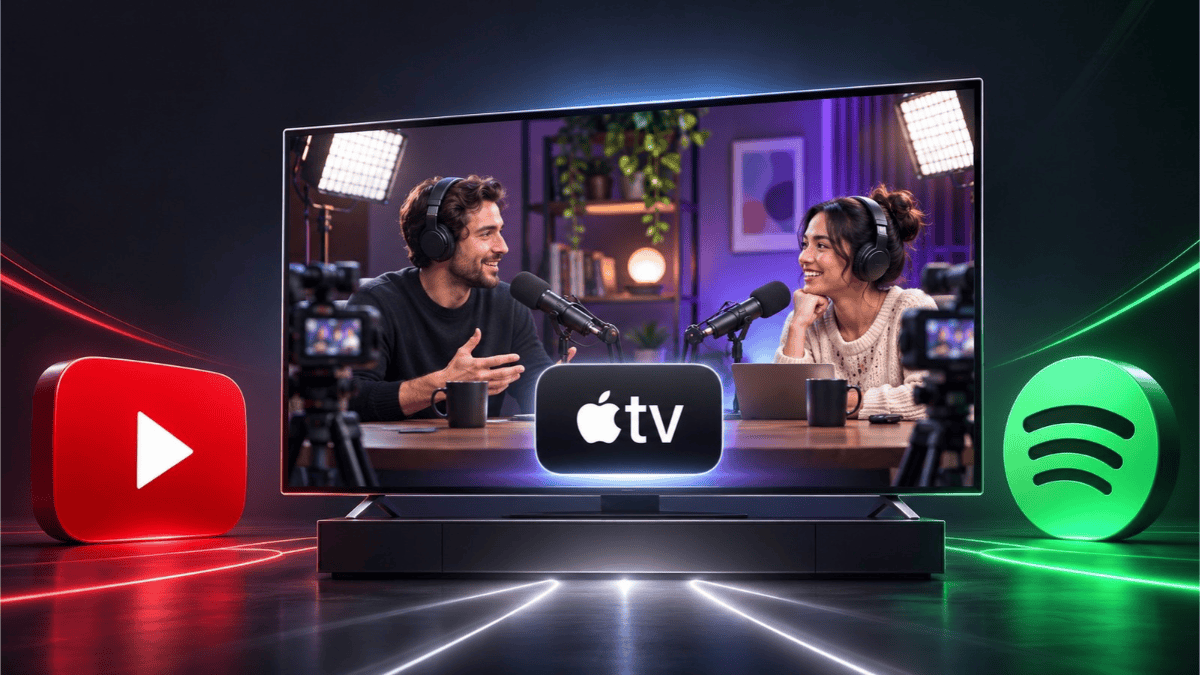
Apple has helped make podcasts popular among many people. Then YouTube and Spotify added cameras, expensive studios and enough flair to make every conversation look extravagant.
Now Apple wants the video audience back.
Yes, that’s right, Apple is bringing free video podcasts to the Apple TV app. Viewers will not need an Apple TV subscription to watch them, which is refreshing news from an industry that usually places another monthly payment between you and the content. The feature has appeared in the second developer beta of Apple’s 27.3 software updates. Once it reaches the public, users will find a dedicated video-podcast section inside the Apple TV app. According to Apple, the initial rollout covers Australia, Canada, Mexico, the United Kingdom and the United States. Unfortunately, South Africa is not on that list yet. But that shouldn’t surprise you, and as with many Apple features, South African users may need to exercise some patience while other countries watch people speak into enormous microphones on their television screens
Now, when it does become available, video podcasts will appear across supported devices running the Apple TV app. That includes iPhones, iPads, Macs, Apple TV 4K boxes, selected smart televisions and compatible set-top boxes. Viewers will be able to begin an episode on one device and continue on another. The experience will be free because it sits outside the normal Apple TV subscription. However, that does not mean every podcast ever created suddenly becomes available without payment. And programmes that require paid subscriptions will not appear in the free section, which seems fair because even Apple cannot give away something another creator has placed behind a paywall. But the change means people can watch participating programmes without subscribing to Apple’s film and television service.
The move places Apple in more direct competition with YouTube and Spotify. YouTube has become one of the largest destinations for podcasts, even though many people continue listening without looking at the screen. Spotify has also invested heavily in video and exclusive podcast content. But it was Apple that helped establish podcasting as a mainstream format through iTunes and the Podcasts app. So, when the medium became increasingly visual, it was rather strange to watch other platforms move faster.
Podcasts originally offered an escape from looking at a screen. You could listen while driving, exercising, cooking or pretending to clean the house. Nobody cared what the hosts were wearing because nobody could see them. Now many podcasts have cameras, producers, lighting departments and carefully designed studios. Hosts refer to clips on the screen, react to facial expressions and occasionally forget that part of the audience can only hear what is happening.
So I guess we need to ask: At what point did a video podcast simply become a talk show with headphones?
And that the answer probably does not matter to Apple. It does not take a genius to understand that video keeps audiences watching for longer and opens more advertising opportunities for creators. It also places another form of entertainment inside the Apple TV app, alongside films, series and live programming. For podcast creators, the feature provides access to television screens without requiring them to build a separate streaming application. A programme filmed for YouTube or Spotify can potentially reach people who prefer watching from the sofa.
That could be particularly useful for interviews, gaming discussions, technology programmes and comedy shows where the visual reactions often form part of the entertainment. Audio-only listeners can continue using the Podcasts app while viewers gain another option. Of course, placing video podcasts inside the Apple TV app may also make the service feel more crowded. Users already enter the app to find shows spread across Apple TV, rentals and other connected streaming platforms. Adding podcasts introduces another row of content to navigate. But hey, free viewing definitely makes the experiment easier to accept.
Apple does not appear to be asking audiences to replace audio podcasts. It is simply admitting that many podcasts have already become television programmes, whether anyone wants to use that description or not. The company helped place podcasts inside our ears. Now it wants them on the largest screen in the house and that is what competition looks like.
