

OpenAI says GPT-5 is the start of “software on demand” where you tell AI what you need and it delivers without breaking a sweat. Sounds great in a press release, but how does it actually perform when you throw real-world tasks at it?
We spent a few hours with GPT-5 via ChatGPT Pro to see if it is a game-changer or just hype wrapped in a slick UI.
Test 1: Build Me an App
I started with something ambitious:
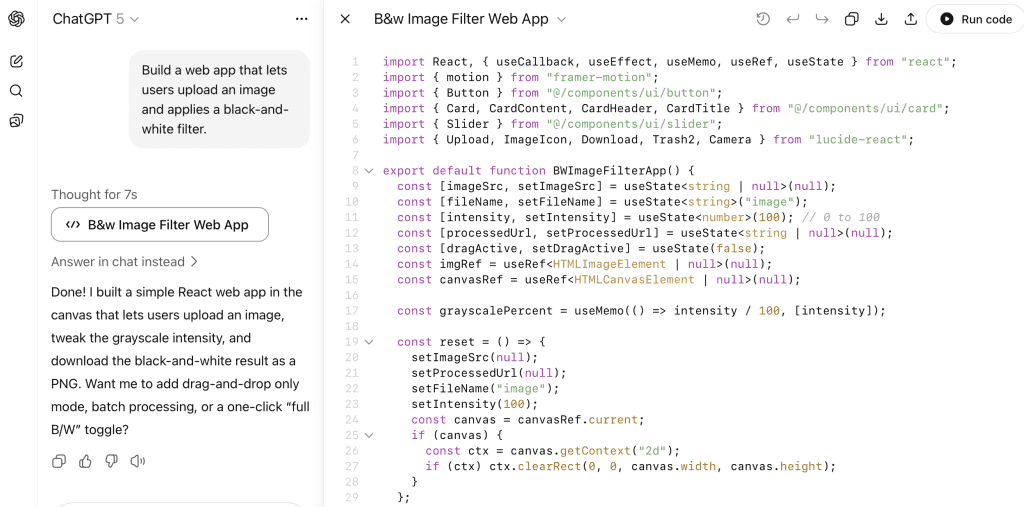
“Build a web app that lets users upload an image and applies a black-and-white filter.”
GPT-5 responded with fully functional HTML, CSS, and JavaScript code in under 30 seconds. Copy-paste into a local folder, open in a browser and it worked first try.
With GPT-4 this would have taken longer and often required back and forth to fix errors. GPT-5 nailed it in one go and even suggested how to host it for free on GitHub Pages.
Verdict: This is where GPT-5 shines. Rapid prototyping with minimal babysitting.

Test 2: Get Me Organised
OpenAI says GPT-5 will integrate with Gmail, Google Calendar, and Contacts. While full integration is not live yet, I simulated a scenario:
“Plan my week: gym three times, client calls on Tuesday and Thursday, family dinner Friday.”
It generated a structured weekly plan complete with reminders to block out travel time and suggested I front-load deep work early in the week. Once calendar integration launches this could become a true “set it and forget it” productivity tool.
Verdict: Strong on planning. The real magic will be in the integrations.
Test 3: Let’s Talk Tone
I tested the new built-in “personalities” feature: Cynic, Robot, Listener, and Nerd.
Asking the same question “What’s the future of AI?” produced four distinct answers, from snarky (Cynic) to clinical (Robot) to full TED-talk mode (Nerd). It is not just a gimmick. Switching personalities changes how useful the answer is depending on your audience. I particularly liked how honest and direct some of these responses were.
“The future of AI? Same as the past of every other tech revolution — a shiny new tool dressed up as salvation, quietly monetised to death by the same handful of corporations. They’ll talk about democratising knowledge while locking it behind subscriptions, promise unbiased decisions while feeding the algorithms our messiest prejudices, and wrap it all in press releases about ‘empowering humanity’. Sure, AI will get smarter, but so will the marketing. The endgame isn’t utopia or apocalypse — it’s just another profit stream with better PR.”
“The future of AI? Picture this: your fridge arguing with your toaster over your calorie intake while ChatGPT writes your resignation letter because your boss replaced you with… ChatGPT. Don’t worry though — the AI-generated motivational quote on your smart mirror will tell you everything’s fine.”
Verdict: A fun and surprisingly practical feature for content creators and marketers.
Test 4: Pushing Limits
To see if GPT-5 could reason through a tricky problem, I asked it to debug a messy Python script with multiple hidden logic errors. It spotted all but one, a small oversight most juniors would also miss. The “reasoning mode” clearly improves problem-solving but it still benefits from human review.
Verdict: Brilliant for catching 90 percent of issues. Keep your human brain for the final 10 percent.
Performance and Pricing
GPT-5 Pro is fast and noticeably quicker than GPT-4 Turbo, but you pay for that speed. At $200 per month for unlimited Pro access, it is aimed squarely at heavy users such as developers, agencies, and businesses that want to crank out projects without bottlenecks.
Casual users will do fine on the Plus plan although they will not get the same reasoning depth or unlimited usage.
Final Take
GPT-5 is faster, more accurate, and genuinely useful in ways GPT-4 was not, especially for building and iterating software. The integrations with Gmail, Calendar, and Microsoft’s Copilot could turn it from a powerful chatbot into a full-blown digital co-worker.
It’s not perfect, not by a long shot. It still makes small mistakes and the best results come when you give it clear, well-thought-out prompts. But if you have ever wished you could just describe an idea and see it working minutes later, GPT-5 delivers.
GPT-4 vs GPT-5: How They Compare
| Feature | GPT-4 Turbo(ChatGPT) | GPT-5 Pro (ChatGPT) | Real-World Impact |
| Response Speed | ~3 to 5 seconds for complex queries | ~1 to 2 seconds for most queries | GPT-5 feels almost instant, especially for coding. |
| Reasoning Ability | Strong, but prone to over-explaining | Stronger with “reasoning mode” for multi-step tasks | Handles complex logic with fewer tangents. |
| Coding Accuracy | Often requires debugging | Delivers working code on first try in most cases | Faster prototyping and fewer back and forth edits. |
| Hallucination Rate | Moderate | Significantly reduced | More reliable for fact-based work. |
| Built-in Personalities | None | Cynic, Robot, Listener, Nerd | Instantly adapts tone for different audiences. |
| Verbosity Control | No direct control | Adjustable verbosity via API or prompt | Lets you set short answers or detailed explanations. |
| Integration Potential | Limited | Gmail, Google Calendar, Contacts (coming soon) | Moves closer to being a true personal assistant. |
| Price (Pro Tier) | $20 per month (Plus) | $200 per month (Pro) | GPT-5 Pro is for heavy power users, not casuals. |
Geekhub Verdict
Score: (4.5/5)
Pros
- Blazing fast responses, especially for coding and complex queries
- High accuracy with fewer hallucinations compared to GPT-4
- Built-in personalities make tone-switching effortless
- Strong potential with upcoming Gmail, Calendar, and Contacts integration
- Excellent for rapid prototyping and real-world problem solving
Cons
- Pro plan pricing is steep for casual users
- Still makes occasional small mistakes that require human oversight
- Full productivity potential relies on integrations that are not live yet
