

Apple events are usually a simple thing to sit through.
Launch a new iPhone, maybe Airpods and an Apple Watch and a slide full of numbers about how many units got shipped, delivered with that particular brand of Tim Cook calm.
Those days are gone.
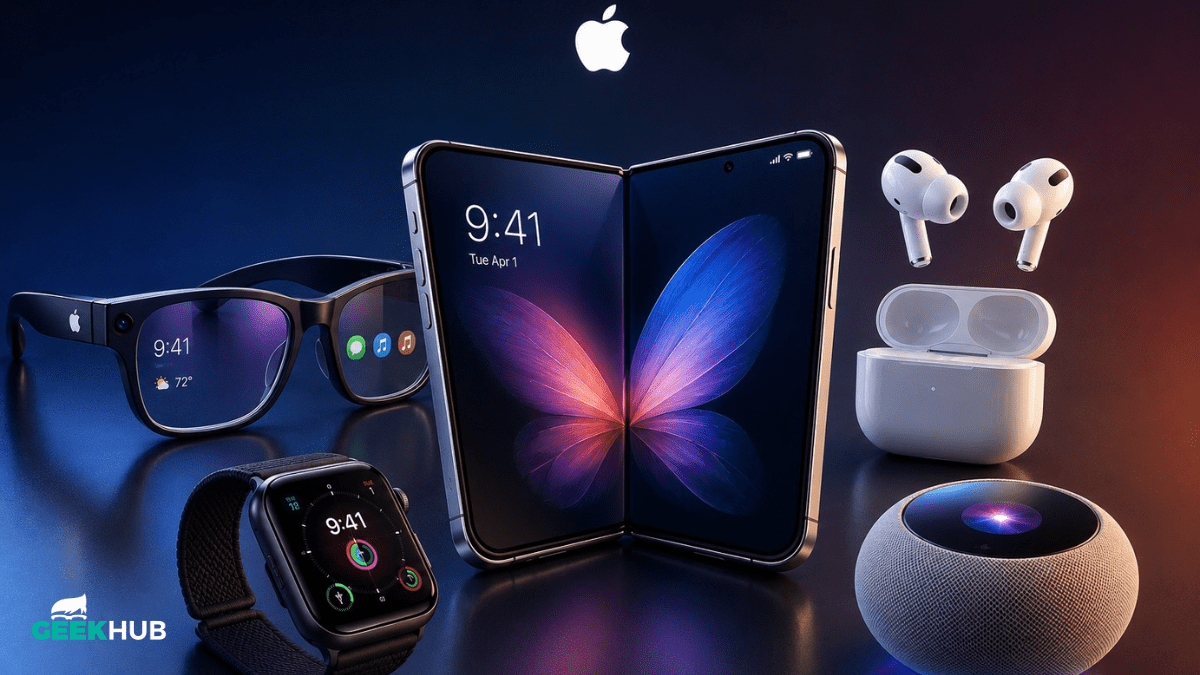
If the latest reports from Bloomberg’s Mark Gurman are anywhere close to accurate, Apple is gearing up for what could be the busiest product cycle in the company’s history. New iPhones, obviously. A foldable iPhone. Smart glasses. AirPods with cameras and AI baked in. Home devices. Fresh Macs and iPads. And a handful of things that don’t fit into any category we currently have a name for.
On the surface it looks like Apple is simply preparing to launch a lot of stuff.
I don’t buy that for a second.
What I think is actually happening is that Apple is quietly building for a world where the smartphone stops being the thing your entire digital life orbits around.
And that is a far more interesting story than another glass rectangle.
The Smartphone Era Is Hitting Its Awkward Adult Phase
The original iPhone changed everything, and that’s not marketing fluff, it’s just what happened.
Before the iPhone, your phone was a tool you used and put down. After it, the phone became a limb. It became your camera, your wallet, your TV, your newspaper, your Gauteng e-toll nemesis, your banking app, your group chat, your everything. For nearly twenty years every major tech company on earth has been building around that one reality.
Something feels different now.
People aren’t sprinting to upgrade every single year anymore, and who can blame them. Flagships and even mid tier devices are already absurdly good. A four-year-old premium phone still does almost everything the average person actually needs, which is part of the reason the local upgrade cycle has stretched out and people are hanging onto handsets the way they used to hang onto cars.
The industry knows this. Apple knows this better than anyone.
Which is exactly why the company’s future is looking less about building a better phone and more about getting you to look at your phone less often.
That’s a genuinely strange sentence to write about the company that built the most successful smartphone in history.
But that’s precisely why it’s worth paying attention.
Apple Has Always Been Comfortable Showing Up Late
One thing Apple almost never gets credit for is patience.
It wasn’t first with the smartwatch. It wasn’t first with wireless earbuds. It wasn’t first with a mixed reality headset. And if the foldable iPhone actually lands next year, it’s arriving to a party Samsung and Huawei and half the Chinese phone industry have been hosting for years.
While everyone else races to be first, Apple usually sits back and watches.
People mistake that for being behind. Often it’s deliberate.
Apple likes letting everyone else make the expensive mistakes first. It studies what works, what breaks, what people genuinely use versus what looks great in a keynote demo and then gathers dust in a drawer. Then it walks in with its own version and acts like it invented the whole thing.
Does that strategy always work? No. Ask anyone who dropped serious money on a Vision Pro and now uses it roughly twice a year. But more often than not, it’s a big part of why Apple is still one of the most valuable companies on the planet.
AI Stopped Being a Feature. It’s Becoming the Plumbing.
For the past few years the entire industry has been obsessed with chatbots.
Every company wanted its own assistant. Every launch turned into a contest over who could spit out text faster or generate the slightly less cursed image of a human hand.
Apple mostly sat it out. At times it genuinely looked like the company had been caught napping while everyone else sprinted ahead.
But the longer I stare at this reported roadmap, the more I think Apple was just playing a different game entirely.
Apple doesn’t seem to want AI to be a place you go. It wants AI to vanish.
Glasses that understand what you’re looking at. Earbuds that know where you are. A home that clocks who’s at the gate before you’ve even asked. An assistant that actually understands context instead of just reacting to commands like a slightly dim intern.
The goal isn’t to get you talking to AI more. The goal is to have technology quietly do its thing in the background while you get on with your actual life.
That’s a very Apple way of thinking, and it’s the part everyone obsessing over chatbot leaderboards keeps missing.
The Product That Matters Most Doesn’t Even Fold
Everyone’s eyes are locked on the foldable iPhone, and fair enough, that’ll be fascinating to watch.
Samsung, Huawei and a long list of Chinese brands have spent years sanding down the rough edges of that category while Apple watched from the sidelines taking notes.
The more interesting move is the reported push into smart glasses.
Because if there’s one product category with a real shot at challenging the smartphone’s throne, it’s wearables. Maybe not next year, but eventually.
The dream every tech company is chasing is simple to describe and brutally hard to build. Technology that becomes invisible. No screen to hold, just the information you need when you need it, and nothing when you don’t.
We’ve heard this promise before and honestly most attempts at it have face-planted spectacularly, Google Glass being the patron saint of the genre.
But for the first time, AI is making that vision feel slightly less like a sci-fi pitch and slightly more like something that could actually ship.
Apple’s Real Problem Isn’t Engineering. It’s Trust.
Building the hardware is hard. Building the software is even harder.
Convincing people to wear a camera on their face all day is a whole different mountain. Although Meta has already started to chip away at that very mountain.
But convincing them to hand an AI their personal life, their location, their habits, the face of every person who walks past their front gate, that’s the hardest sell of all.
Many people are excited about AI, but there’s a whole lot more that are deeply nervous about it. We want convenience, yes but we also want privacy. We want smarter tech that doesn’t make us feel like we’re being quietly watched and monetised.
That balancing act is probably what decides whether Apple’s next decade looks as good as its last.
The Bigger Picture
What actually fascinates me here isn’t the products. It’s what they reveal.
For years the industry has been hunting for the next big thing. The next iPhone moment. The next platform shift. The next device that genuinely changes how humans interact with technology rather than just adding another camera lens.
Maybe we’re finally getting close.
Or maybe we’re watching an industry talk itself into believing the future is arriving faster than it really is, which, let’s be honest, would not be the first time.
Both are entirely possible.
But one thing is getting clearer by the day. The companies that win the next decade won’t necessarily be the ones with the smartest AI models or the highest benchmark scores. They’ll be the ones that make technology feel the most human.
And if this roadmap is even half right, that’s exactly the bet Apple is placing.
