

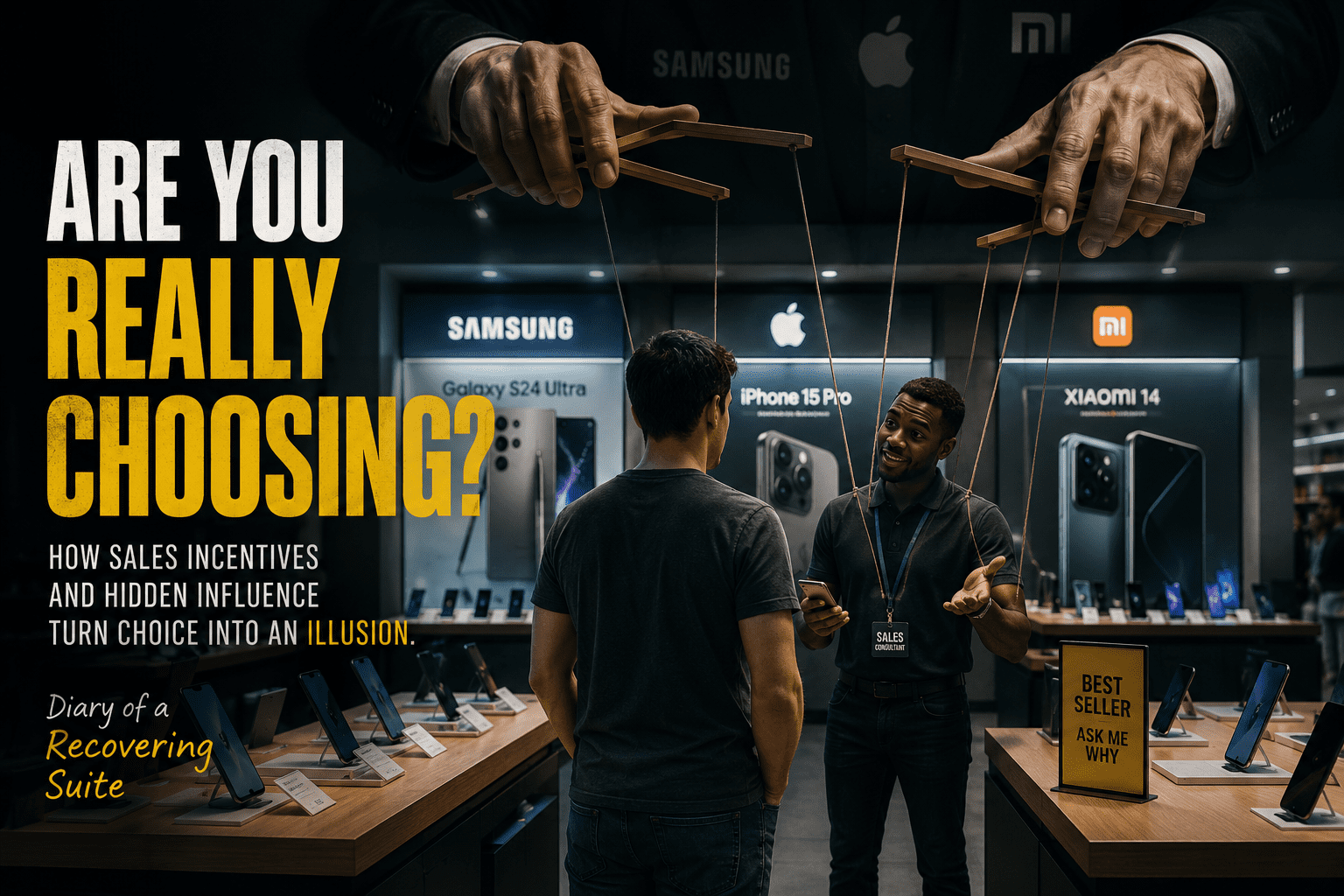
There was a moment during my corporate career that I wish I could unsee.
I was sitting in a meeting discussing sales incentives for a new smartphone launch. The conversation wasn’t about the camera or the latest innovation. It wasn’t even about whether the product was actually better than the competition.
The discussion was about one thing.
How much we were willing to pay a sales consultant to recommend it.
That was the day I started questioning something most consumers never think about.
When you walk into a store to buy a smartphone, are you actually choosing?
Or has somebody already made that choice for you?
As a recovering suit, these are the things that keep me awake at night.
For years, I believed in the free market fairy tale. Build a better product, price it competitively, market it effectively, and consumers will decide who wins.
Then I spent two decades inside the machine and what I discovered was far less romantic.
The smartphone industry, and increasingly much of the technology industry, runs on incentives. Not consumer demand or product superiority. Incentives.
Walk into almost any major network operator or retailer and you’ll find a battlefield hidden in plain sight.
Every smartphone on display is fighting for attention. Every brand wants the best shelf position and the biggest display stand. Every brand wants their logo hanging from the ceiling or wrapping the windows.
But the most valuable real estate isn’t the shelf. It’s infact the person standing next to it.
The sales consultant.
Because when most consumers enter a store, they don’t know exactly what they want. Most will claim they do, but they don’t. They know they need a phone, they know their budget. Maybe they’ve watched a few YouTube videos or read some reviews.
Then they ask the most dangerous question in retail.
“What would you recommend?”
That’s the moment the game changes and the brands know it.
What most consumers don’t realize is that recommendation often has a price tag attached to it.
Brands routinely pay incentives to sales staff for selling specific products. Sometimes it can be a few hundred rand and sometimes it’s well over a thousand rand per device. Even the franchisee or dealers are incentivised with cash or lavish gifts just to stock more of a certain brand.
The thing is, the consultant isn’t necessarily lying. The phone might genuinely be good.
But human beings are human beings.
If one device puts R1,500 in your pocket and another puts nothing in your pocket, which one are you likely to mention first?
The answer is obvious.
And yet we continue pretending the recommendation is objective.
Here’s where things become uncomfortable.
The biggest brands can afford these incentive programs.
Smaller brands often cannot.
Which means consumers don’t necessarily hear about the best product. They hear about the product with the biggest budget.
I’ve seen fantastic devices fail because they couldn’t compete financially at store level.
I’ve also seen mediocre devices outperform expectations because they could.
That’s not consumer choice. That’s influence.
And before we get too self-righteous about retail stores, let’s talk about social media.
The same dynamic exists there.
Influencers are paid, reviewers receive the latest products, algorithms promote certain content while search results prioritize others.
The modern consumer is surrounded by invisible hands nudging them toward decisions while simultaneously convincing them they’re making those decisions independently.
The technology industry loves talking about empowerment. But empowerment requires transparency.
You can’t make an informed choice if you don’t know who is influencing the information you’re receiving.
Now don’t get me wrong. This isn’t a criticism of sales consultants. They’re doing their jobs.
It isn’t even necessarily a criticism of brands. They’re competing in a system that rewards influence.
I am critical of the illusion.
The illusion that the market is a perfectly neutral arena where the best product wins.
Because it definitely isn’t and it never has been.
The older I get, the more I realize that consumer choice often looks like a menu someone else designed.
You can choose anything on the page. But you didn’t write the menu.
As consumers, we like to believe we’re rational decision-makers.
The truth is often far from that.
Most of us are choosing from a shortlist that was curated long before we arrived.
Long before we entered the store, opened that YouTube video or clicked “buy now.”
The irony is that the internet was supposed to democratize information. Instead, it created thousands of new ways to influence people while making that influence harder to see.
So what should consumers do?
The simple answer is be a bit more skeptical.
Ask why a product is being recommended. What alternatives weren’t mentioned. Who benefits from your decision.
And most importantly, remember that recommendations are very rarely neutral.
Most reviews aren’t completely neutral either, heck even I have personal preferences that may on occasion influence my opinion and influencers are most certainly not.
The biggest difference is that some of us are willing to admit it.
That’s one of the strange things about becoming a recovering suit.
Once you’ve seen how the machine works, you can never quite look at the showroom floor the same way again.
