

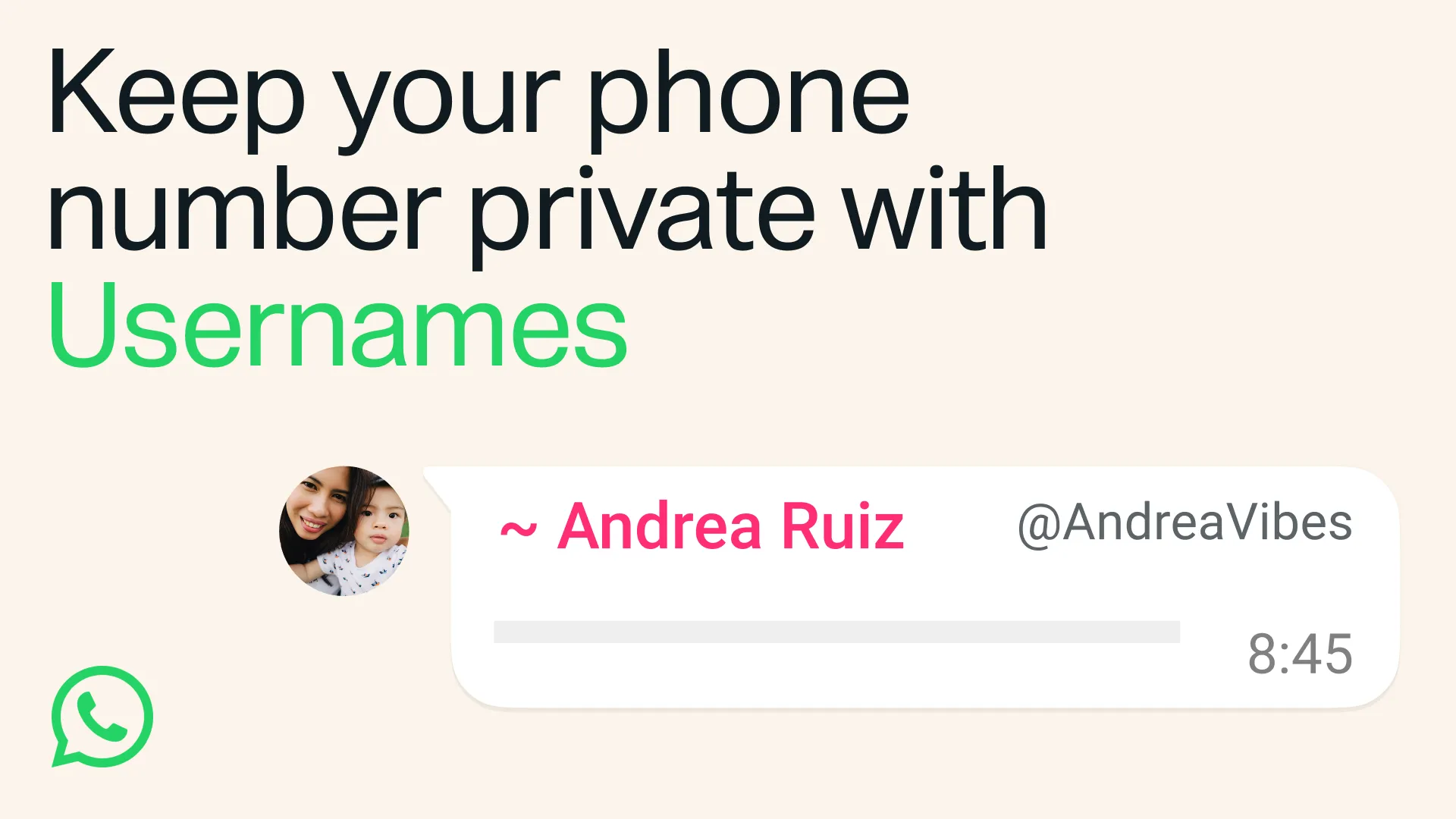
WhatsApp has always worked on one simple rule. Your phone number was your identity. It was your login, your contact card, and the thing every stranger needed before they could reach you. That worked fine in 2009 when nobody thought twice about who had their digits. It works a lot less fine in 2026, when your number is tied to your banking app, your two-factor codes, your eWallet, and roughly every part of your digital life that actually matters.
So when WhatsApp announced this week that it is finally rolling out usernames, letting people chat without handing over their phone numbers, my first reaction was “Finally”, the most-used app in this country is catching up to everyone else.
What is actually happening
Meta confirmed that username reservations opened on Monday, with the feature itself rolling out gradually over the coming months. You can claim your handle now, but the part where strangers stop seeing your number lands later this year. The reason they opened reservations early should give you a sense of the scale here. WhatsApp now sits at more than three billion users, and with that many people, the good names get taken fast. They are giving everyone a head start before the land grab begins.
There are rules however, and they are worth knowing before you waste your favourite handle on something the system rejects. Usernames run between three and 35 characters, they have to include at least one letter, and you are limited to lowercase letters, numbers, periods, and underscores. No spaces, no symbols, and nothing that looks like a web address, so forget about anything starting with www or ending in .com or .net.
I opened my settings, and there was nothing there. Here is why
This is the part nobody is explaining clearly, so let me save you the confusion I went through. I updated my app, headed to Settings, then Account, expecting to find the Username tab everyone online is talking about, and it simply was not there. If you are reading this in South Africa and you just did the same thing and came up empty, you are not locked out, and the feature has not skipped us.
What is happening is that the reservation phase is rolling out account by account, not country by country in one switch. Even inside the same country, not every account gets it on the same day. WhatsApp flips it on in waves, and when your turn comes you will get an in-app notification telling you the reservation screen is ready. So the absence of that tab right now means your specific account has not been reached yet, nothing more.
It helps to think of this as two separate timelines, because conflating them is where the confusion comes from. The first is the reservation phase, which is happening now in staggered waves and lets you lock in your handle early. The second is the actual feature going live, the part where your number genuinely disappears from view for new contacts, and that only fully arrives later this year. So even the people who can reserve today are not yet hiding their numbers. They are just first in the queue.
Two practical things before you give up and assume you have been forgotten. Make sure your app is genuinely on the latest version, because the tab will not appear on an older build no matter where you sit in the rollout, and a surprising number of us are running whatever version installed three updates ago. And know that there is a priority order baked in. If you already have an Instagram or Facebook handle, WhatsApp gives you a faster, verified path to claim the matching name through Meta’s Accounts Center, while anyone without an existing Meta username waits a little longer. So if you run a side hustle, or any kind of public profile already tied to a Meta account, you are likely closer to the front of the line than you think.
When the tab does land, the process itself takes seconds. You go to Settings, then Account, then Username, type your desired handle, and the app checks availability instantly. If your first choice is gone, it serves up suggestions built off what you typed, and once you are happy you tap save and you are done. You can change it later too, as long as the new one is free.
The privacy bit is the whole point
Here is what I actually like about how WhatsApp built this. Unlike Instagram or Telegram, there is no searchable directory. Nobody can browse for you, and there are no suggestions surfacing your handle to people you have never met. If someone wants to contact you for the first time, they need to know your exact username already. That single design choice is the difference between a privacy feature and a stalker convenience tool, and they got it right.
On top of that you can switch on an optional username key, which works like a second layer of access. Even if someone has your handle, they cannot start a conversation without also knowing the key. During this reservation phase the key is a four-digit code, and WhatsApp says it upgrades to a proper alphanumeric code once the feature goes fully live. Messages from anyone who does not have your key drop into a requests folder rather than landing straight in your chats.
Your phone number does not disappear, to be clear. It stays attached to your account for login, verification, and recovery. It just stops being the thing you are forced to hand out every time you want to talk to someone new.
Why this matters more here than in most places
WhatsApp is late, and that is fine
Let me not pretend this is some revolutionary leap. Telegram has had usernames since 2014. Signal added them in 2023. WhatsApp, with a user base that dwarfs all of them combined, is the last big messenger to the party. Alice Newton-Rex, who heads product at WhatsApp, framed it around giving you control over who sees your number in the first place, which is the correct framing even if it is arriving about a decade later than it could have.
But scale changes everything. Signal getting usernames matters to the privacy-conscious few. WhatsApp getting usernames matters to basically the entire connected population of this country. When the app that everyone uses changes how identity works, that is the change that actually filters down to your aunt, your domestic helper, your delivery driver, and the WhatsApp business on your street selling Vetkoek. That is the version that matters.
The Meta catch worth watching
There is one wrinkle I would keep an eye on. If you are a creator, small business, or organisation, WhatsApp lets you claim your existing Instagram or Facebook username so your identity stays consistent across Meta’s platforms. Convenient, sure. But using the same handle across WhatsApp, Instagram, and Facebook quietly stitches those profiles together, which is the opposite of privacy if you were hoping to keep your personal and public lives separate.
For most of us that trade-off is fine. For anyone who deliberately keeps a wall between their public brand and their private number, the smart move is to pick a WhatsApp username that does not match your Instagram, so nobody can connect the dots with a single search. Meta has also been careful to say usernames do not change its business model, pointing instead toward its new Business Agent AI tooling, so do not expect this to suddenly make the platform more private at a structural level. It is a user-facing control, not a philosophical shift at Meta.
My take
Keep your app updated and wait for the notification. That is the honest advice right now, because for most South African accounts the reservation tab simply has not arrived yet, and there is nothing you can do to jump the queue beyond making sure you are on the latest version. When it does land, claim your handle straight away, because the names will go fast and there is no downside to locking yours in early. It is optional, your number still works exactly as before if you do nothing, and the whole thing costs you about ten seconds.
What I find more interesting than the feature itself is what it signals. WhatsApp spent fifteen years treating your phone number as sacred and unchangeable, and it is finally admitting that the thing it built its entire identity system on had become a liability for the people using it. That is a significant admission, and in a country where WhatsApp is less an app and more a utility, it is the kind of change that earns its headline.
