

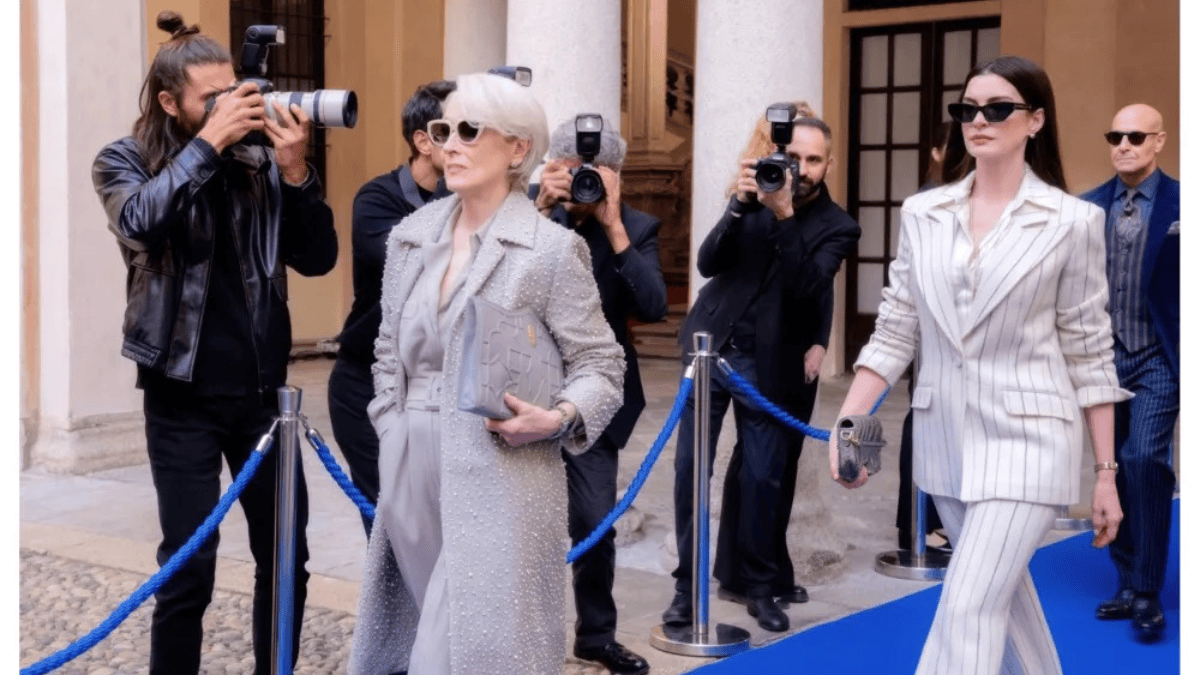
There are movies that immerse you to such a degree that you become apart of it without even noticing it. In fact you wake up the next morning and seriously start considering spending your savings on a plane ticket. The Devil Wears Prada 2 appears to have accomplished that with ease. Twenty years ago, the original film had audiences obsessing over Chanel boots, designer handbags and a certain cerulean sweater. Today its sequel is doing something slightly different. It’s increased tourism in Milan.
Not literally, of course. Miranda Priestly hasn’t diversified into real estate just yet. But according to Variety, The Devil Wears Prada 2 has sparked increased interest in Milan, with tourists seeking out locations connected to the sequel. And suddenly Hollywood has reminded us that films don’t only influence what we wear, listen to or buy. It has a way of influencing our travel plans as well.
But this isn’t really a new concept. Movies and television have been creating travel bucket lists for decades behind the scenes. We watch characters walk through beautiful cities, eat at tiny restaurants, stand beneath famous landmarks or disappear into landscapes that look so mesmerrising that the location stops being a backdrop and becomes somewhere we want to experience ourselves. The difference today is how quickly we can make that happen.
Twenty years ago, you watched Andy Sachs race through New York carrying Miranda Priestly’s coffee and perhaps thought it would be amazing to visit those streets one day. Today you can watch The Devil Wears Prada 2, pull out your phone before the credits have finished rolling, search for the exact location, find a hotel nearby, check flights and potentially book the entire trip before you’ve even left the cinema. That’s quite a leap.
Technology has collapsed the distance between seeing somewhere and actually experiencing it. And The Devil Wears Prada 2 couldn’t have picked a better city to demonstrate that. Milan already carries an enormous reputation as one of the world’s fashion capitals. It’s home to luxury fashion houses, spectacular architecture, designer boutiques and Milan Fashion Week. This is a city that hardly needed Miranda Priestly to tell the world it had style.
But Hollywood adds something tourism advertising can’t always manufacture. A story.
While a beautiful photograph of Milan can make you think, I’d love to visit there, watching characters you love walk through those same streets can make you think, I want to stand in that exact spot. And there is a huge difference in that. Because once cinema attaches an emotion, character or memorable moment to a location, we automatically start imagining ourselves inside the story. And The Devil Wears Prada has always been particularly good at selling that fantasy.
The original movie wasn’t simply about fashion, but about access to a world most people would never experience. The clothes, parties, offices, hotels and glamorous cities were all part of that appeal. And if you watched it you know that Andy’s transformation wasn’t only about changing her wardrobe. She stepped into an entirely different lifestyle, which is very appealing to audiences even though it’s now twenty two years later. Yes I know, there is a very slight chance of becoming Miranda Priestly or receiving racks of unreleased designer clothing which quite frankly feels deeply unfair. But Milan? Oh we can certainly go there.
As for social media it has poured rocket fuel onto this phenomenon. Travelling somewhere because you saw it in a movie is one thing. Travelling there, recreating the scene, photographing it and uploading the evidence to Instagram or TikTok turns the experience into something else entirely.With this we can go from watching fictional characters experience beautiful places to standing in those locations ourselves, phone in hand, trying to capture our own version of the scene. You can call it set-jetting, screen tourism or simply the irresistible human urge to stand somewhere famous and take seventeen photographs until one looks effortless.
Whatever you call it, the entertainment industry has enormous power to shape the places we want to experience which comes with real economic value attached to it. When a major movie showcases a destination, the benefits can stretch far beyond the cinema. Hotels gain visitors. Restaurants gain customers. Tour operators create experiences. Local businesses benefit from travellers who arrive wanting to experience a little piece of what they saw on screen and suddenly a movie isn’t only selling tickets. It’s selling destinations.
That’s what makes the reaction surrounding The Devil Wears Prada 2 so interesting. Twenty years ago, the franchise influenced fashion trends and introduced millions of people to a glamorous, exaggerated version of the fashion industry. Now it’s influencing travel. So has the way we experience movies changed? Absolutely, we don’t simply want to watch anymore. We want to experience the entire thing and of course take enough photographs to ensure everyone at home knows we did it. Movies have always allowed us to escape somewhere else for a couple of hours.
Technology has simply made it easier to stay there once the credits roll. Now that’s the real power of cinema. For two hours it allows us to visit somewhere we’ve never been. And occasionally, when the lights come back on, we decide that watching simply wasn’t enough.
We want to go there.
Preferably wearing Chanel boots.
