
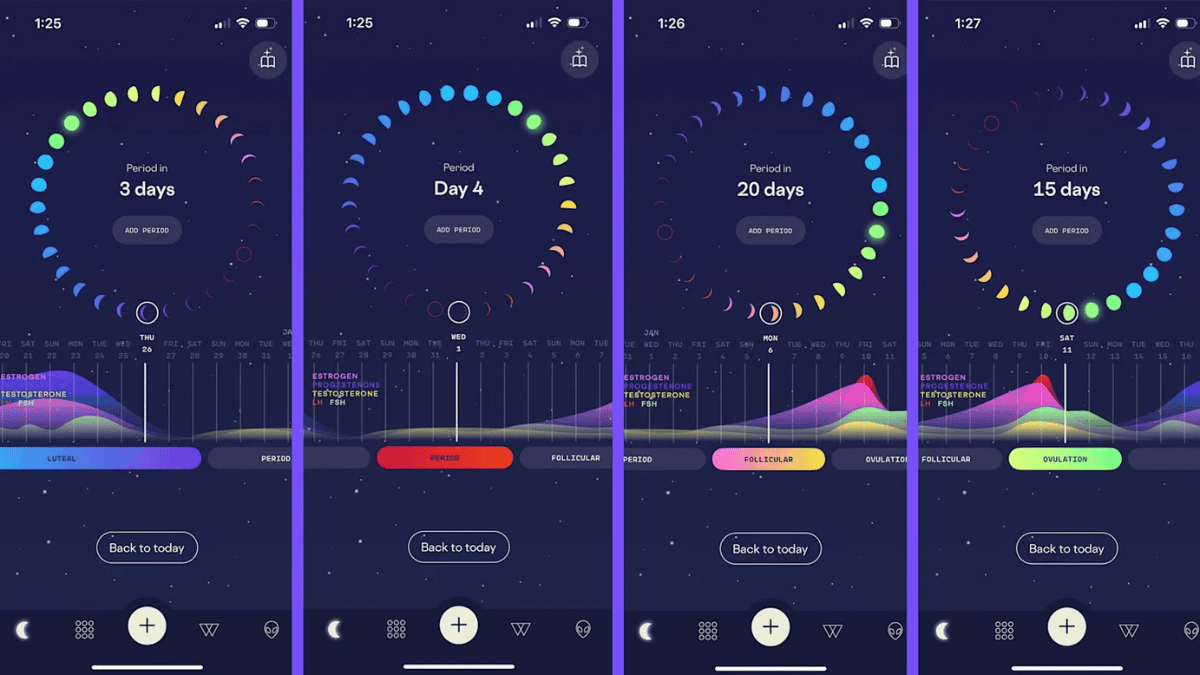
Mother Nature has always kept her own calendar and taught women how to read their own bodies for centuries. Women had hand written journals, circles on calendars and whispered conversations between mothers and daughters. But more importantly there was a deeply intimate relationship between a woman and the rhythms of her own biology. It was a time when every cycle, every symptom and every change told a story which was sacred. Granted, it wasn’t always convenient, and never totally predictable, but that knowledge was hers, and hers alone. All this, long before smartphones started buzzing with reminders that you are about to ovulate or that your period is due in three days
Today, we’ve handed that responsibility to apps like, Flo, Clue, Stardust, Spot On, Period Calendar and Euki, where that private information is shared with a Silicon Valley company. Our private and personal information is stored on a server we will never see, in a country we may not live in, and under terms and conditions none of us actually read.
Don’t get me wrong. I fully agree that technology has done some incredible things. Period trackers help women manage irregular cycles, prepare for pregnancy, understand your raging hormones, and even spot potential health issues that might otherwise go unnoticed. And the truth is that for millions of women, these apps have become genuine tools of convenience. All beautifully designed. All helpfully synced to the cloud. And all of it potentially visible to people you never agreed to share it with. The Mozilla Foundation, the organisation behind the Firefox browser, recently investigated the privacy practices of six of the most popular period tracking apps.
For me the problem isn’t the technology. It’s what happens to the information once we’ve trusted it with some of the most intimate details of our lives. A recent BBC report, based on research by the Mozilla Foundation, found that while some popular period-tracking apps have strengthened their privacy protections, others still share user data with major technology and advertising companies. In some cases, that includes companies like Google, Meta and TikTok, alongside advertising analytics firms that most users have probably never heard of. Let’s stop and think about that for a second.
For those of you that think that your menstrual cycle is just another data point, it’s time to think again. This is information that can reveal whether you’re trying to conceive. If you’re pregnant or if you’ve experienced a miscarriage. If your cycle is changing, or your body is signalling that something might be wrong. This information is as sensitive as it gets and yet we’ve reached a point where we often hand it over by tapping “I Agree” without reading a single line of the privacy policy. If anything, we’ve become remarkably casual about giving away pieces of ourselves all in the name of convenience. Because convenience has quietly become more valuable than caution.
The hard truth is that we have all signed a deal with the digital world without even realising it. Think about it, maps know your exact destinations. Streaming services…..they have your watch history. Online stores know what products meet your fancy. And the phone you carry knows your sleep patterns, where you work and how many steps you take each day. Quite the stalker, would’t you agree? Somewhere along the way, we stopped valuing our data and just gave it away without a second thought. That should actually concern us. The irony is that many of these apps exist to help women understand their bodies better which is a good thing, because knowledge empowers people. And better information can lead to better healthcare and improved conversations with doctors. But empowerment starts to look very different when the information you’re sharing becomes valuable to someone else.
Nobody can deny that data has become one of the world’s most valuable commodities. All you need is to look close enough to realise that we’re no longer just the customer. In fact, in many cases, we’ve also become the product. Welcome to the uncomfortable reality of the digital age. And this isn’t just about period trackers, oh no! This is about every app that discretely collects little bits and pieces of our lives until it knows us better than we know ourselves.
I have to laugh… because if someone knocked on your front door and asked, “Excuse me, could I have your medical history, your shopping habits, your location, your sleep patterns and a rough idea of your emotional state?” you’d probably close the door become perplexed. But if the same thing is asked through a Terms and Conditions pop-up…Well, apparently all it takes is a bright blue Accept button.
I’ve said it before and I’ll say it again, technology and the period-tracking apps are not the enemies. The real issue is transparency. If companies want our most personal information, they should tell us exactly why they need it, who they’ll share it with. For how long will it be kept, and what they’ll do with it. Not bury it somewhere on page 47 of a privacy policy written by people who clearly charge by the syllable. Mother Nature never asked us to surrender our privacy in exchange for understanding our own bodies.
Perhaps it’s time we stopped assuming that progress has to come with that price tag.
