

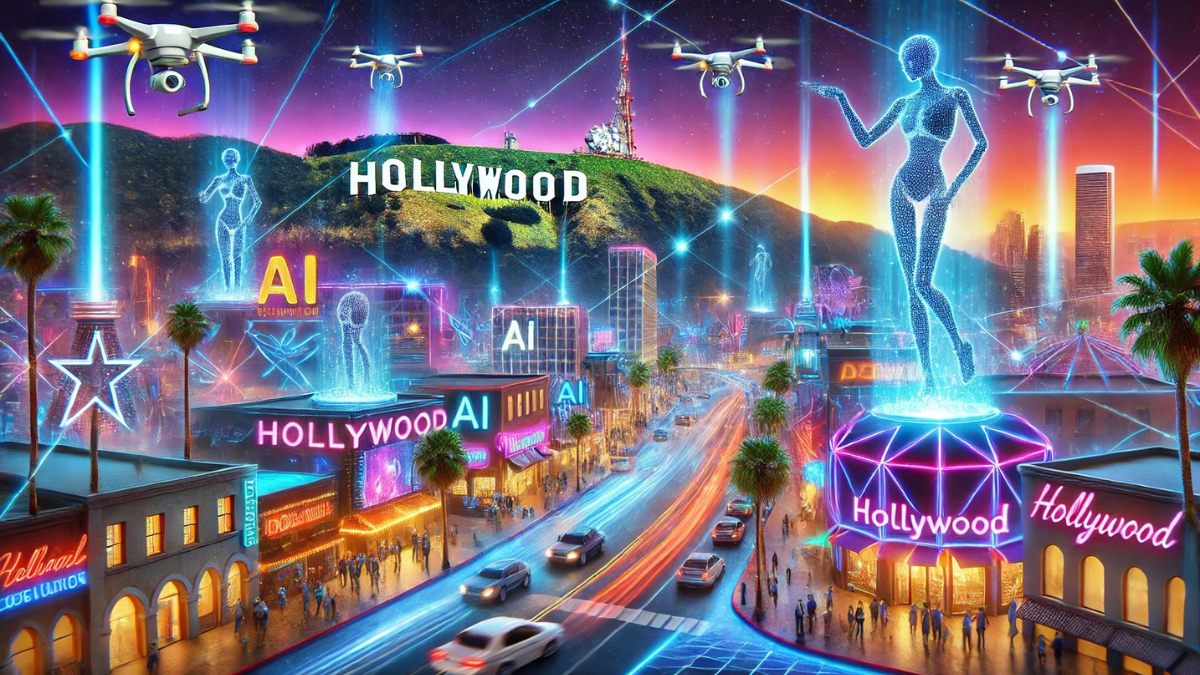
For more than a century, if you wanted to make a movie that looked like Hollywood, you pretty much needed Hollywood. You needed millions of dollars, cameras, sets, actors, visual-effects teams, editors, sound designers and eventually a studio willing to take a very expensive chance on your idea.
Basically, you needed someone with deep pockets to say yes. Artificial intelligence may be about to make that word considerably less important.
Much of the conversation surrounding AI and filmmaking has focused on what it could replace. For actors, it is about their likeness and for writers are about their scripts. Among those that have questioned what these technologies could mean for their livelihoods are artists, animators and visual-effects professionals. In fact, some Hollywood creatives are now being paid to train AI systems in the very skills they spent years developing.
But there’s another side to this conversation that I find just as fascinating.
What happens if AI doesn’t replace filmmakers? What happens if it allows filmmakers to replace Hollywood?
It is common knowledge that independent directors are already experimenting with generative AI. Generative AI is now used to create shots, environments and effects. And all this would have previously required huge budgets as well as production teams. So it it makes sense that some filmmakers believe these tools could allow them to bypass major studios and take creative risks without the worry of traditional financing. A total game changer.
Imagine you’re an aspiring filmmaker sitting in some tiny town nobody in Hollywood has ever heard of. You’ve written an incredible science-fiction movie, but there’s one small problem. Your script requires spaceships, enormous cities, creatures and an alien planet. Good luck pitching that with your bank balance. Traditionally, the scale of your imagination had a rather inconvenient relationship with the amount of money available to you. The bigger the idea, the bigger the budget.
While AI could potentially break that relationship, making a great movie still requires something technology has yet to solve. To start off with, a brilliant idea together with characters that audiences care about is required. Then you need pacing, emotion, humour, tension and the human ability to know when a scene works and when it doesn’t. AI can make an explosion cheaper but it cannot automatically make us care about the person running away from it.
As always the most important factor is economics, which is becoming difficult to ignore. Runway CEO Cristóbal Valenzuela argues that AI could eventually allow studios to make dozens of films for the price of a single $100 million blockbuster. Now apply that thinking to independent filmmakers. If technology dramatically reduces the cost of creating convincing visual effects, environments, storyboards and other expensive parts of production, suddenly the gates surrounding professional-looking filmmaking become considerably lower. And that’s where Hollywood should probably start paying attention. Because Hollywood’s greatest advantage has never simply been creativity because brilliant storytellers exist everywhere.
The advantage has always been a case of access, to money, technology, talent, and production infrastructure. But perhaps most importantly, access to distribution. Also there are enormous unresolved questions surrounding copyright, training data, jobs and who gets compensated when creative work helps build these systems. Those questions cannot simply disappear because the technology is impressive. And yes we are aware that AI won’t magically eliminate all of those advantages. But we’ve watched this kind of disruption before.
YouTube has allowed people sitting in bedrooms and kitchens to build audiences that rival television networks. Smartphones turned ordinary people into photographers and filmmakers. Streaming has clearly weakened television’s control over when and where audiences watch entertainment. Every time technology lowers the barrier to entry, somebody who previously controlled the gate becomes a little less powerful. And its only a matter of time before
AI does something similar to filmmaking. So perhaps the most interesting movies of the next decade could come from a complete stranger. From a place Hollywood wasn’t looking. But from someone who finally has the tools to put what exists inside their imagination onto a screen. That possibility excites me considerably more than watching AI generate another celebrity deepfake. Because perhaps the biggest question about artificial intelligence and Hollywood isn’t whether AI will replace filmmakers.
It’s whether AI will give millions of filmmakers the opportunity to compete. Hollywood has spent more than a century deciding which stories were expensive enough to tell.
It may soon have to compete with people who no longer need permission to tell them.
