

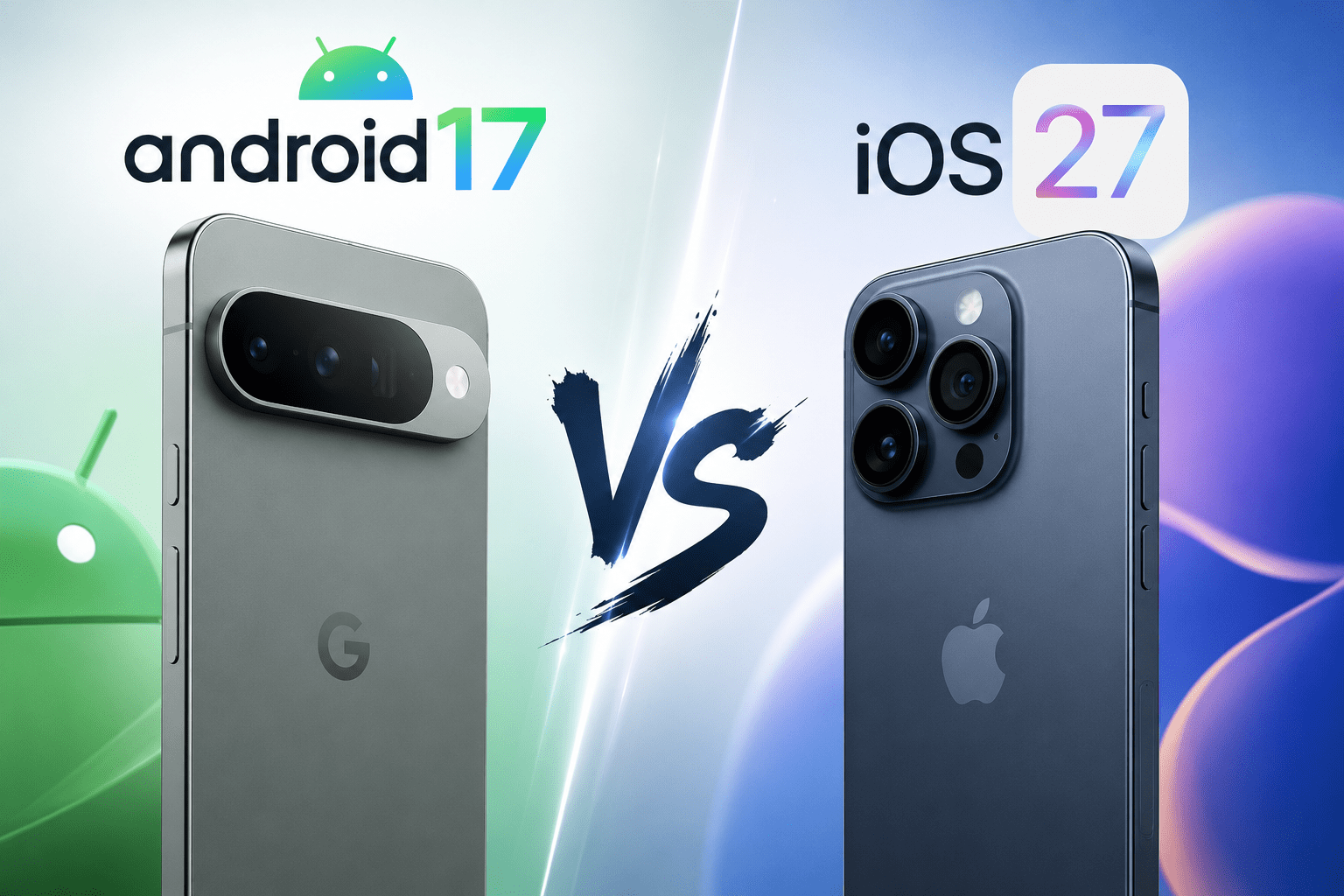
Let me lay my cards on the table before we start, because pretending to be neutral here would be dishonest and you would smell it a mile off. I am an Apple person. I have a MacBook, an iPad, an Apple Watch on my wrist, an Apple TV under the screen, and a HomePod that controls everything after the fifth time of asking. When someone AirDrops me a photo it just appears without the slightest bit of friction, and in those little moments of things-just-working is the entire reason people like me have handed Apple a decade of loyalty and a frankly embarrassing amount of money.
But I also keep an Android phone in my other pocket, because the job requires it, and 2026 has been the year that secondary phone started making me uncomfortable, because the gap I have spent years justifying to friends and family has quietly closed to the point where the honest answer to “why are you still on iPhone” is becoming “because I already am.” Yes, that is not a reason, it’s inertia wearing a reason’s clothes.
With iOS 27 now out in beta and Android 17 already pushing to phones as a stable release, this feels like the right moment to actually look at both, properly, and ask the question I have been avoiding.
What is actually new, on both sides
Let’s deal with the headlines first, because both companies have shipped real updates rather than the usual coat of fresh paint.
Apple’s big swing with iOS 27 is, finally a more capable Siri. The rebuilt Siri AI is now far more conversational and context-aware, built on the next generation of Apple Foundation Models and, notably, Google’s Gemini. Read that last part again, because it tells you something about where the power actually sits in this rivalry. Beyond Siri, Apple is promising serious performance gains, including roughly 30 percent faster app launches and a photo library that loads about 70 percent quicker, along with much faster AirDrop and file transfers. There is a smarter Photos app with Spatial Reframing that lets you shift the perspective of an old photo using on-device models, plus an upgraded Clean Up and generative Extend feature. Safari now groups your tabs into topics, watches pages for price drops or restocks, and can build extensions from a plain-language description. And Apple has refined its Liquid Glass look from last year, this time handing you a system-wide slider to control how transparent the whole thing is, which is Apple quietly admitting people found it hard to read.
There are genuinely clever touches too. Wallet can now generate a digital pass from a photo of a physical ticket, there is a bill-splitting feature that scans a receipt and divides it up over Apple Cash, and the Phone app surfaces context like a flight number when you call an airline. All very useful, polished and very Apple.
Now look at Android 17, which is the more interesting release if you actually pay attention. Its headline feature, Bubbles, lets you turn any app into a floating window by long-pressing its icon, so you can keep notes or maps or a tutorial hovering over whatever else you are doing. There is a foldable gaming mode that splits the screen between game and controls, Screen Reactions for recording yourself over your screen, perfect for content creators, and a meaningfully stronger security story. That security work is the part Apple people should not skip past. Android 17 lets you grant an app temporary, one-session access to your precise location, share only specific contacts instead of your whole address book, and lock a stolen phone with your biometrics so a thief with your passcode still cannot get in.
And then there is Gemini. The genuinely ambitious stuff, Gemini Intelligence, a system-level AI layer that can automate tasks across apps, fill forms and build custom widgets, is rolling out separately through the year and needs newer, beefier hardware. But the direction is unmistakable. While Apple had to phone Google for help with Siri, Google is shipping agentic AI that does things across your phone rather than just talking to you.
The similarities are now the whole story
Here’s the part that’s actually pushing me to justify my setup.
For years, the iPhone’s killer feature was not really any single feature. It was the ecosystem, the way everything snapped together, and the one piece of that everyone could point to was AirDrop. You could not get that on Android. Except now you can. Quick Share is already compatible with AirDrop on Pixel and a host of select Android devices, and Google is expanding it through 2026 to more Samsung, OPPO, OnePlus, Vivo, Xiaomi and HONOR devices, with a QR-code cloud fallback for everything else. Google did not even ask Apple’s permission, they reverse-engineered the thing and built it in with independent security audits.
Messaging, the other great blue-bubble dividing line, has quietly dissolved too. RCS between Android and iPhone now supports end-to-end encryption, and Apple has added an iPhone-to-Android transfer tool in iOS 26.3, partly under pressure from Europe’s Digital Markets Act. The walls of the garden, the actual bricks that made leaving feel impossible, are being dismantled from both sides. Some of it Apple chose but most of it, they were pushed into.
So when I line up iOS 27 and Android 17 side by side, what I see is not two different philosophies anymore. I see two mature operating systems that both do fast AI assistants, both do cross-platform file sharing, both do clever Photos editing, both do encrypted messaging to each other, both do strong privacy controls. The feature checklist, the thing I used to win arguments with, now mostly cancels out.
So why am I still here
This is where I have to be honest rather than tribal. The reason I am still on iPhone in 2026 has almost nothing to do with the iPhone being better and almost everything to do with the other six Apple devices in my life and a dozen other Apple devices used by my family. My watch talks to my phone talks to my Mac talks to my TV, and that hum of continuity is real and it is lovely and I would miss it badly. Apple did not lock me in with a single great phone. It locked me in with a watch that only fully works with that phone, a HomePod that wants that phone, an iMessage history my whole family lives inside.
That is not a functional argument. That is a switching-cost argument. And those are two very different things, even though Apple has spent years and a fortune in marketing making sure we confuse them.
Android in 2026, especially if you live on a Pixel or a Galaxy, is not the compromise it was when I first picked a side. In some areas, particularly anything involving AI that actually does things rather than just chats, it is ahead. The honest position is the one I suspect a lot of long-term iPhone people are quietly arriving at, which is that the choice between iOS and Android has finally become what fanboys always insisted it wasn’t, a matter of taste. Do you want the polish, the consistency, the slightly controlling parent who keeps everything tidy? Or the flexibility, the floating windows, the AI that reaches into your apps and the sense that nobody is deciding on your behalf what your phone is allowed to do?
Neither answer is wrong. That is the whole point, and it is a genuinely new place to be standing.
For me, the truthful conclusion is uncomfortable. I am not staying with Apple because it is better. I am staying because leaving is expensive and I am comfortable, and “comfortable” is exactly the feeling a walled garden is designed to produce. The garden is still beautiful but I just noticed, for the first time in ten years, that the gate has been quietly left open, and that I keep finding reasons not to walk through it.
Ask me again after I have lived with iOS 27 and Android 17 properly for a few months. I genuinely do not know what I will say, and for someone this entrenched, that uncertainty is the most interesting thing to happen to this debate in years.
