

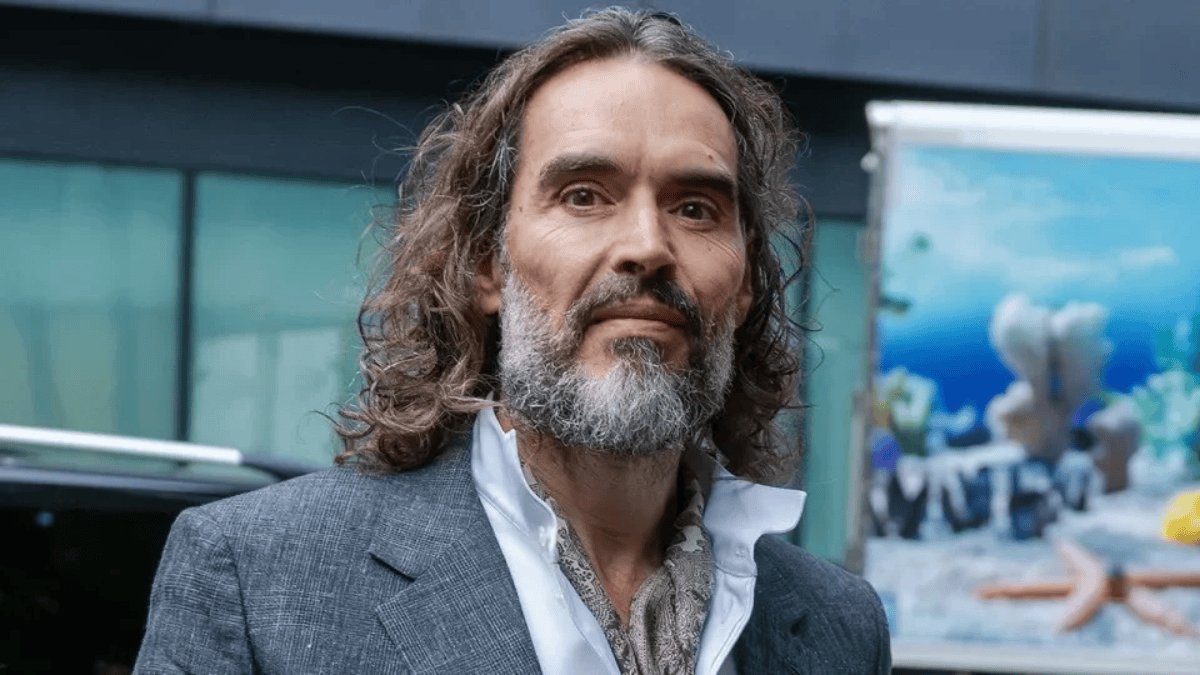
Russell Brand, the man who spent years building a career around being the loudest person in the room. I loved that he was unpredictable, provocative and rarely interested in making anybody feel comfortable. Unfortunately, he is now sitting inside a courtroom.
The British comedian and actor is standing trial at Southwark Crown Court in London. He faces three counts of rape, three counts of sexual assault and one count of indecent assault. The charges relate to six women and concern alleged incidents between 1999 and 2009. Brand has pleaded not guilty to every charge.
Now you’re probably thinking, “That’s what they all say”, right?
Brand was described as “ruthless”, “calculating” and “manipulative” by the prosecution. Prosecutor Riel Karmy-Jones told the jury that the six women encountered Brand through work, social events or performances during the years when his public profile was growing. Variety. The prosecution alleges that Brand treated women as targets and used his fame, personality and influence to get close to them. The alleged incidents reportedly took place in several locations, including workplaces, a hotel, a bar and Brand’s home.
Are these serious allegations? Without a doubt, they certainly are. But they remain allegations.
The jury has only heard the beginning of the prosecution’s case. Brand’s lawyers will have the opportunity to challenge the evidence, question witnesses and present his defence. He denies every accusation, and the court has not reached a verdict. The fact that most people already have an opinion about Russell Brand makes reporting on on his trial very difficult.
Some remember the comedian with the enormous hair who appeared on British television, hosted radio programmes and eventually moved into Hollywood films. Others know the political commentator who built a large online following. More recently, he has spoken about religion and presented himself as a man who has changed.
Then there are those who decided what they believed when allegations first appeared publicly in 2023. What we often forget is that courtrooms cannot work like social media. I don’t think a court can reach a guilty verdict based on how irritating, charismatic or unlikeable somebody appears. Nor can it treat a large following as evidence of innocence. The jury has to consider what happened to each woman, what evidence supports the allegation and how the defence answers it. And there is no magic to make those answers appear any faster. So taking into account the sensitivity of the case, the process will take time.
The prosecution told jurors that the women do not know each other. According to its case, they came forward separately after previous media investigations encouraged them to report their experiences. Prosecutors also acknowledged that the alleged offences took place many years ago.
The length of time between an alleged incident and a trial will probably become an important part of the case. Memories will have to be revisited. Records may no longer exist. The defence may challenge why complaints were not made earlier. But delayed reporting does not automatically prove that an allegation is false. In the same way, an allegation does not automatically prove that an accused person is guilty.
This is precisely why trials exist.
It may sound obvious, but the internet is not particularly good at waiting for evidence. We’ve seen it a million times. A dramatic headline appears and people instantly go on a rampage. Old interviews return. Video clips are removed from their original context and every facial expression automatically becomes proof of something. Within a week or two, the person on trial stops being a defendant and becomes a character in whatever story the viewer has already chosen.
And that is where the danger lies for everyone involved.
Just as the women deserve to have their allegations heard seriously and without abuse. Brand also has the right to defend himself before an impartial court. Those two principles do not cancel each other out, no matter how desperately online arguments try to make them do so.
But there is a much larger question sitting beneath this trial. Fame can do many things. It can create access and place people in rooms others cannot enter. It can surround a public figure with employees, fans and people who may feel uncomfortable challenging them. But fame can also distort the way accusations are received. Supporters may treat criticism as persecution, while others may assume that a controversial public image proves criminal behaviour.
Neither approach helps a jury determine what happened.
Brand’s public personality will inevitably hover over the trial. He spent years presenting himself as sexually confident, chaotic and impossible to control. The prosecution may argue that his status and behaviour form part of the context surrounding the allegations. His defence will have the opportunity to offer a different account. But let’s not forget that a public persona is not a verdict. The court must deal with evidence rather than reputation. That means listening carefully, separating proven facts from claims and resisting the urge to turn the proceedings into entertainment.
The trial is expected to continue for several weeks. More details will emerge, and some may be difficult to hear. Until the jury reaches its decision, the most responsible position is also the least exciting one.
Pay attention. Take the allegations seriously. And allow the evidence to speak before the internet does so on everybody’s behalf.
